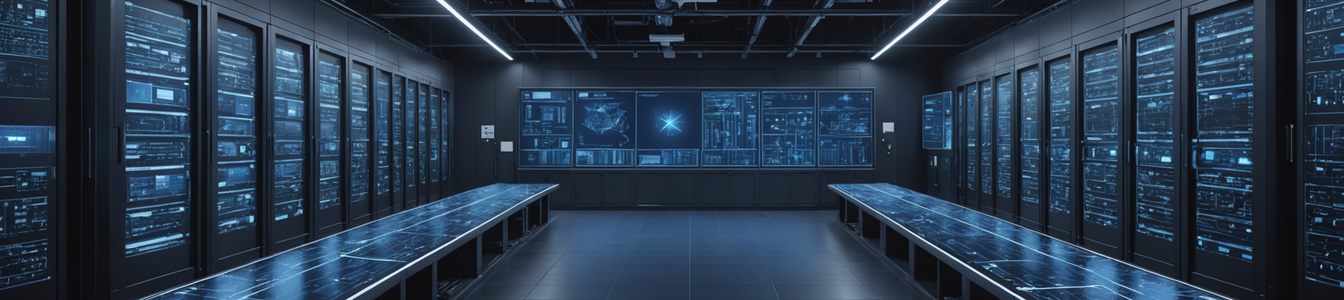
The global race for artificial intelligence supremacy is no longer confined to algorithms and software. It has sparked a massive, physical building boom for the infrastructure required to train and run these systems. This expansion—spanning hyperscale data centers, strained power grids, and smart manufacturing facilities—is weaving a new fabric of critical infrastructure. For cybersecurity professionals, this represents not just a scaling challenge, but the emergence of a profoundly interconnected and vulnerable attack surface: the AI-Physical Infrastructure Nexus.
The Data Center Dilemma: Local Regulation Meets Global Demand
The strain is becoming visible at the local level. In regions like Bernalillo County, New Mexico, officials are actively considering imposing strict limits on the construction of new AI data centers. The concerns are multifaceted: immense water consumption for cooling, staggering electricity demands that can overwhelm local grids, and the physical security implications of concentrating critical computational power. This regulatory pushback is a direct response to the voracious appetites of AI clusters, which can consume more power than small cities. From a security perspective, these concentrated hubs become high-value targets. An attack that disrupts cooling, power, or physical access to such a facility could cripple multiple AI services simultaneously, creating cascading failures across dependent industries. The security model must expand from protecting data in the center to securing the utility lifelines and supply chains that feed it.
Funding the Automated Backbone: OT Security in the Spotlight
Concurrently, significant capital is flowing into companies that build the physical and automated backbone for this ecosystem. Vention's recent $110 million funding round to accelerate AI-driven manufacturing automation is a case in point. This push brings AI directly onto the factory floor, where robots and programmable logic controllers (PLCs) governed by AI models handle precise manufacturing tasks, including for critical components like server racks and cooling systems. The cybersecurity implication here is the accelerated erosion of the air gap. Industrial control systems (ICS) and operational technology (OT) environments, historically isolated, are now deeply integrated with IT networks to feed data to AI and receive optimized instructions. This integration exposes previously isolated systems to ransomware, supply chain attacks, and sophisticated malware designed to cause physical disruption or intellectual property theft. Securing this convergence requires a specialized blend of IT security expertise and deep OT/ICS knowledge, a skillset in critically short supply.
The Hardware Supply Chain: A New Strategic Battleground
The cycle extends to raw materials and fabrication. Companies like Live Ventures' Central Steel Fabricators are now highlighted as strategic participants in the AI data center and connectivity infrastructure cycle, supplying essential structural components. This underscores a crucial, often-overlooked layer of the nexus: the physical supply chain. The security of a data center is only as strong as the integrity of the bolts, racks, and conduits within it. Adversaries, including nation-states, could target this supply chain with tampered components that create physical vulnerabilities (e.g., components that fail under specific thermal conditions) or embed malicious hardware for later exploitation. This moves the threat upstream, forcing cybersecurity and procurement teams to collaborate on vendor risk management for physical goods with the same rigor applied to software dependencies.
Converged Threats and a Holistic Security Posture
The AI-Physical Infrastructure Nexus creates a cascade of converged threats. A cyber-physical attack on a regional power grid could black out the data centers it supports. A ransomware attack on a smart manufacturing plant could halt production of the specialized hardware needed to build more data centers. The attack surface is multidimensional, spanning digital, physical, and supply chain vectors.
Recommendations for Cybersecurity Leaders:
- Adopt a Zero-Trust Architecture for OT/IT Convergence: Implement micro-segmentation and strict access controls between AI/IT networks and industrial control systems. Assume the internal network is already compromised.
- Expand Risk Assessments to Encompass Physical Dependencies: Model failure scenarios that include disruptions to power, water, cooling, and hardware supply chains. Conduct tabletop exercises with facilities management and utility providers.
- Invest in OT-Specific Security Monitoring: Deploy solutions that understand industrial protocols (e.g., Modbus, PROFINET) to detect anomalies that could indicate manipulation of physical processes.
- Strengthen Supply Chain Security for Physical Components: Implement hardware provenance verification and tamper-detection standards for critical infrastructure components.
- Engage with Regulators and Urban Planners: The cybersecurity community must have a voice in local and national planning discussions about AI infrastructure siting and resilience standards.
The era of AI is fundamentally an era of infrastructure. Protecting the intelligence requires securing the concrete, steel, and silicon it runs on. The cybersecurity mandate has expanded beyond the logical layer to encompass the entire physical ecosystem that makes AI possible. The resilience of our future digital economy depends on defending this new nexus today.
Comentarios 0
Comentando como:
¡Únete a la conversación!
Sé el primero en compartir tu opinión sobre este artículo.
¡Inicia la conversación!
Sé el primero en comentar este artículo.