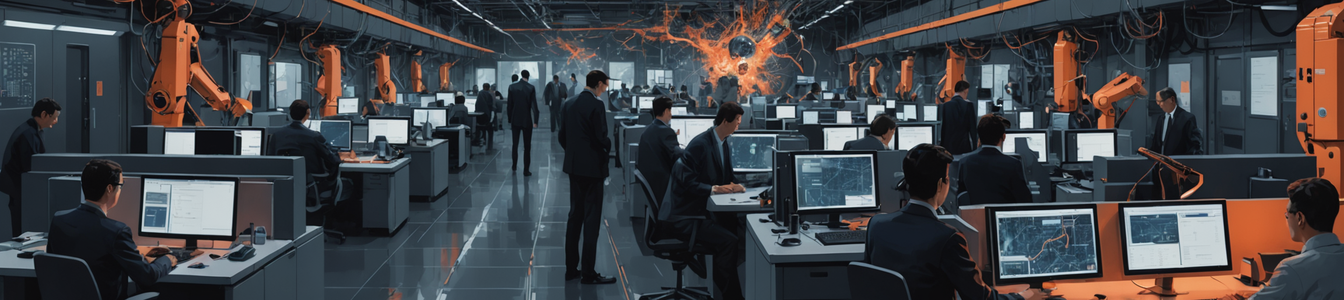
The promise of artificial intelligence has always been framed as a story of progress: greater efficiency, explosive economic growth, and a new era of human potential. But as 2026 unfolds, a darker narrative is emerging on the streets of Seoul and in the employment statistics of Beijing. The AI boom is not just reshaping industries; it is fundamentally destabilizing the global workforce in ways that create profound new risks for cybersecurity professionals.
This is not a hypothetical future. It is happening now. And for those responsible for protecting digital assets, the connection between labor unrest and security posture has never been more critical.
The Samsung Crisis: When Record Profits Breed Resentment
On April 23, 2026, thousands of Samsung Electronics workers gathered in front of the company's headquarters in Suwon, South Korea, holding signs demanding higher wages and threatening to strike. This is not a routine labor dispute. The Samsung union, representing over 30,000 employees, is threatening the first strike in the company's 56-year history. The trigger? An AI-driven explosion in semiconductor profits that has not been shared with the workforce.
Samsung's chip division has been a primary beneficiary of the global AI infrastructure buildout. As demand for high-bandwidth memory (HBM) chips used in Nvidia's AI accelerators skyrocketed, Samsung posted record operating profits in Q1 2026. Yet, wage growth for factory workers and engineers has lagged significantly behind. The union is demanding a base salary increase of 8.5% and a larger share of the performance bonus pool, which has swollen due to AI-related demand.
From a security perspective, this is a red flag. A disgruntled workforce with access to sensitive fabrication facilities, intellectual property, and supply chain systems represents a significant insider threat. The semiconductor industry is already a prime target for state-sponsored espionage. When employees feel undervalued, the risk of data exfiltration, sabotage, or collusion with external actors increases exponentially. The threat of a strike also raises concerns about operational continuity: if critical security personnel walk off the job, who is monitoring the network for intrusions?
The Chinese Employment Crisis: AI as a Job Killer
Half a world away, a different but equally alarming trend is unfolding. China's National Bureau of Statistics reported that the unemployment rate for the 25-29 age group, a key demographic for economic stability, has risen to 7.2% in March 2026, a significant jump from 5.8% just six months prior. Economists attribute this spike directly to the rapid adoption of AI in manufacturing, customer service, and data processing.
Chinese factories, long the backbone of global supply chains, are increasingly replacing human workers with AI-powered robotic systems. Chatbots have replaced millions of call center agents. AI-driven accounting and legal software have eliminated entry-level positions in finance and law. The result is a generation of young, educated workers who are finding themselves locked out of the labor market.
For cybersecurity, this creates a different kind of threat surface. Economic desperation is a powerful motivator for cybercrime. We are already seeing an increase in sophisticated phishing campaigns and ransomware attacks originating from regions with high youth unemployment. When legitimate career paths are blocked, the underground economy becomes an attractive alternative. Furthermore, the social unrest that often accompanies high unemployment can lead to physical security risks for corporate offices and data centers in affected areas.
The Convergence: Labor Instability as a Security Risk
These two stories, though separated by geography and culture, are symptoms of the same disease: the AI labor paradox. The technology that is generating unprecedented wealth for corporations is simultaneously destroying the economic security of the workers who built those corporations. The result is a volatile mix of resentment, desperation, and opportunity for malicious actors.
For CISOs and security leaders, this requires a paradigm shift. The traditional threat model focuses on external attackers: hackers, nation-states, and cybercriminals. But the AI labor paradox introduces a new class of internal and external threats driven by economic factors.
Key Security Implications:
- Insider Threat Escalation: Employees facing wage stagnation or job loss in AI-disrupted industries are more likely to engage in malicious insider activity. This includes data theft, intellectual property exfiltration, and system sabotage. Companies undergoing AI-driven restructuring must implement enhanced monitoring and access controls.
- Supply Chain Risk: Labor unrest at key suppliers like Samsung can disrupt the global semiconductor supply chain. A strike could delay shipments of critical chips, forcing downstream companies to seek alternative, potentially less secure, sources. Security teams must map their supply chain dependencies and develop contingency plans.
- Social Engineering Amplification: High unemployment creates a pool of potential victims for sophisticated social engineering attacks. Attackers can pose as recruiters for AI companies, using fake job offers to deliver malware or steal credentials. The desperation of job seekers makes them more susceptible to these tactics.
- Rise of AI-Powered Cybercrime: As legitimate job opportunities dry up, skilled workers may turn to the cybercrime economy. This influx of talent could lead to more sophisticated attacks, including AI-generated deepfake phishing, automated vulnerability discovery, and large-scale credential stuffing.
- Physical Security Threats: Protests and strikes, like those at Samsung, can escalate into physical security incidents. Security teams need to coordinate with local law enforcement and implement robust physical security protocols for facilities in volatile areas.
Actionable Recommendations for Security Leaders:
- Conduct a Labor Risk Assessment: Evaluate the economic stability of your workforce and key supply chain partners. Identify roles and regions most vulnerable to AI-driven disruption.
- Enhance Insider Threat Programs: Implement behavioral analytics to detect changes in employee behavior that may indicate disgruntlement or economic distress. Focus on employees with access to critical assets.
- Develop Supply Chain Resilience: Map your dependency on AI-driven industries like semiconductor manufacturing. Identify alternative suppliers and establish buffer stock for critical components.
- Strengthen Security Awareness Training: Educate employees about the increased risk of social engineering attacks targeting job seekers. Provide resources for financial and mental health support to reduce desperation-driven risk.
- Monitor the Socioeconomic Threat Landscape: Integrate labor market data and news about labor unrest into your threat intelligence feeds. A strike at a key supplier should trigger a security review.
Conclusion
The AI revolution is not a seamless transition. It is a disruptive force that is creating winners and losers at an unprecedented pace. The labor unrest at Samsung and the unemployment crisis in China are early warning signs of a broader instability that will define the next decade. For cybersecurity professionals, ignoring this human dimension of AI is no longer an option. The security of our digital systems is inextricably linked to the economic security of the people who build, maintain, and protect them. The AI labor paradox is not just an economic problem; it is the next great cybersecurity challenge.
Comentarios 0
Comentando como:
¡Únete a la conversación!
Sé el primero en compartir tu opinión sobre este artículo.
¡Inicia la conversación!
Sé el primero en comentar este artículo.