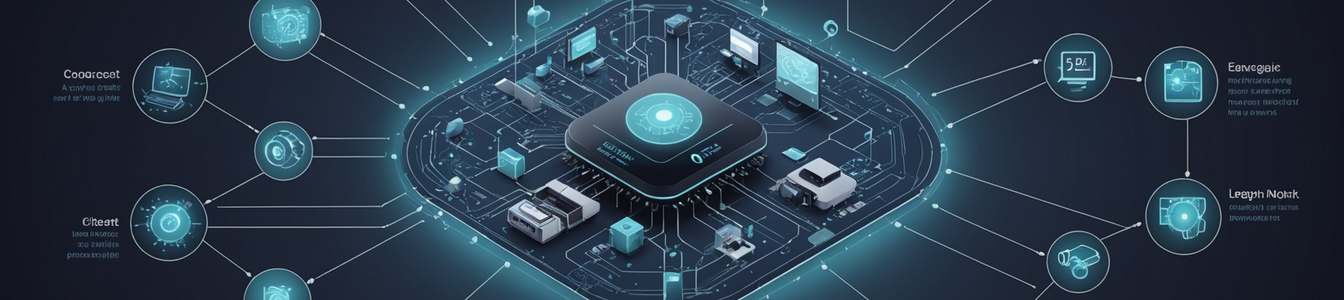
The narrative at Mobile World Congress 2026 was unequivocal: the future is not just connected, it is intelligently autonomous at the edge. The convergence of Artificial Intelligence and the Internet of Things (AIoT) moved from conceptual slides to tangible silicon and software, with major players unveiling platforms that embed decision-making capabilities directly into the fabric of connectivity. This paradigm shift, while unlocking transformative use cases, presents a seismic challenge for cybersecurity professionals, fundamentally altering the threat model for billions of future devices.
Chipmakers Push Intelligence to the Extreme Edge
The drive for localized intelligence was evident across the semiconductor landscape. Nordic Semiconductor, a leader in low-power wireless, used MWC to accelerate its cellular IoT strategy with new product releases. These chipsets are designed to bring efficient, always-on connectivity to a broader range of sensors and endpoints, effectively expanding the network's intelligent periphery. More critically, the industry is moving beyond simple connectivity co-processors. The integration of AI accelerators or dedicated cores for on-device machine learning (ML) turns these endpoints into "smart nodes" capable of preprocessing, analyzing, and acting on sensor data without constant cloud consultation.
This trend was further exemplified by Qualcomm's announcement of its next-generation X105 modem. Beyond its touted ability to maintain robust connections in challenging environments like elevators and underground garages—a feature that extends the IoT's reach—the modem's architecture likely incorporates advanced signal processing that borders on AI. The security implication is profound: the communication layer itself is becoming smarter and more autonomous. A compromised or manipulated modem with embedded AI could make malicious decisions about network selection, data routing, or signal spoofing that are extremely difficult to detect from the network core.
The Rise of "Physical AI" and Autonomous Ecosystems
The concept of "Physical AI"—where AI models interact directly with the physical world through sensors and actuators—took center stage, notably through the LoRa Alliance. The alliance outlined how LoRaWAN, a leading Low-Power Wide-Area Network (LPWAN) technology, is teaming up with Physical AI to maximize value. This involves running lightweight AI models directly on remote sensors in agricultural, industrial, or urban settings. For instance, a camera trap in a field could identify a specific pest and trigger a localized response, all without transmitting vast amounts of video data.
From a security standpoint, this creates a hyper-distributed attack surface. Each sensor becomes a potential point of failure where the AI model could be poisoned via adversarial physical attacks (e.g., presenting misleading visual patterns) or where the device's decision-making logic could be hijacked. The low-power, intermittent nature of many LoRaWAN devices makes traditional security monitoring and patch deployment exceptionally challenging.
The vision of autonomous ecosystems was made tangible by HONOR's showcase, which included a "Robot Phone" and a humanoid robot. These devices represent the culmination of AIoT: systems that perceive, reason, and act in human environments. The cybersecurity risks here escalate from data theft to physical safety. An exploited robot or advanced autonomous device could cause direct physical harm, violate privacy through unsupervised surveillance, or be used in coordinated swarms for malicious purposes. The attack vectors blend traditional embedded system vulnerabilities with novel risks from the AI/ML pipeline, including model theft, evasion attacks, and data integrity breaches.
Redefining the Cybersecurity Perimeter: From Cloud to Trillions of Edges
The collective announcements at MWC 2026 signal the irreversible erosion of the traditional network perimeter. Security can no longer be conceived as a fortified castle (the cloud/data center) with guarded gates. The castle walls have dissolved, and intelligence now resides in every brick, tile, and outpost.
Key security challenges emerging from this AIoT convergence include:
- Hardware-Based Root of Trust as a Non-Negotiable: With AI making decisions on-device, ensuring the device's immutable identity and the integrity of its boot process is paramount. Hardware security modules (HSMs), secure enclaves, and Physical Unclonable Functions (PUFs) must become standard in cost-sensitive IoT chipsets.
- Securing the AI/ML Supply Chain: The integrity of the AI model loaded onto a sensor or modem is as critical as the firmware. Organizations need verifiable chains of custody for models, from training on curated data to deployment, ensuring they haven't been tampered with or embedded with backdoors.
- Lifecycle Management for "Set-and-Forget" Devices: The industry's push for decade-long battery life in remote sensors conflicts with the need for security updates. New paradigms for secure, minimal-over-the-air updates and protocols for cryptographically verifying the health of dormant devices are urgently required.
- Behavioral Anomaly Detection at the Network Level: As devices become more autonomous, network security systems must evolve to detect anomalous behavior rather than just malicious traffic. A fleet of agricultural sensors suddenly coordinating to send false data, or modems exhibiting unusual network-scanning patterns, could indicate a compromised AI model.
- Cross-Layer Attack Vectors: The integration of cellular, satellite (hinted at in next-gen connectivity roadmaps), and LPWAN like LoRaWAN creates complex hybrid networks. An attacker might exploit a vulnerability in a low-security LPWAN sensor to gain a foothold and pivot to attack the more capable cellular gateway it reports to, blending tactics across protocol layers.
Conclusion: A Call for Proactive Architecture
The innovations showcased at MWC 2026 are not future speculation; they are the blueprints for the next wave of digital infrastructure. For the cybersecurity community, the time for reaction is over. The complexity introduced by agentic AI at the edge, combined with ubiquitous and resilient connectivity, demands a proactive, architecture-first approach. Security must be designed into the silicon, the AI models, and the network protocols from the outset. The race is no longer just about connecting everything; it's about ensuring that an intelligently connected world is also a resilient and secure one. The alternative is an internet of vulnerable, autonomous things—a risk the industry cannot afford.
Comentarios 0
Comentando como:
¡Únete a la conversación!
Sé el primero en compartir tu opinión sobre este artículo.
¡Inicia la conversación!
Sé el primero en comentar este artículo.