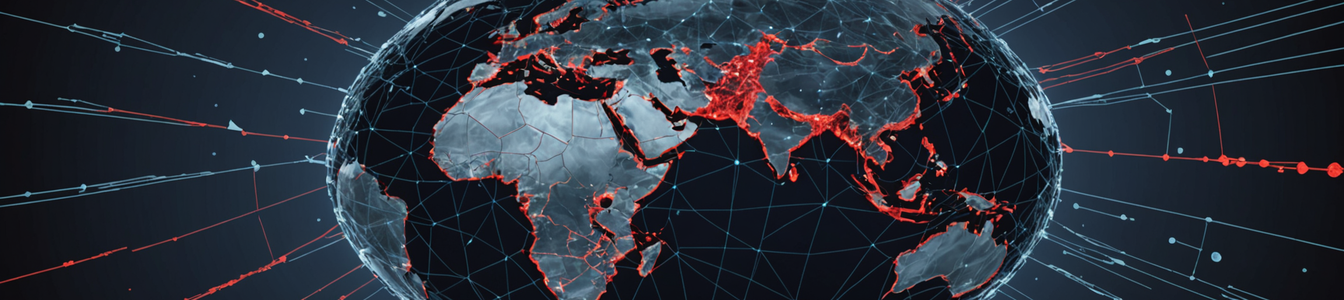
The announcement of a geopolitical ceasefire often brings sighs of relief in diplomatic circles, but for the digital systems underpinning global commerce and security, it frequently marks the beginning of a new phase of instability. The current reported ceasefire involving Iran, following earlier revelations that former U.S. President Donald Trump sought a truce in March, exemplifies this dangerous phenomenon. Rather than calming digital waters, the fragile peace has triggered a violent 'whiplash' effect, exposing critical vulnerabilities in maritime logistics, financial markets, and the very threat models cybersecurity professionals rely on.
Maritime Logistics: A Digital Supply Chain Under Siege
The immediate physical impact is stark in the Strait of Hormuz, a critical chokepoint for global oil and cargo shipments. While vessel traffic is projected to improve to just 25% of pre-war levels, this slow recovery is overshadowed by a more insidious threat. Maritime intelligence reports and chart analysis indicate that Iran may have deployed sea mines in the strategic waterway. This action transforms a key logistics corridor into a persistent, low-grade threat environment.
For cybersecurity and operational technology (OT) teams, this is not merely a physical blockade. Modern shipping relies on integrated digital systems for navigation, cargo management, and port logistics. The presence of sea mines forces a drastic recalculation of routes and schedules, disrupting the finely tuned data flows of global supply chains. Port management systems, vessel traffic services, and Just-In-Time inventory networks must all violently readjust, creating windows of opportunity for cyber intrusion amidst the operational chaos. The 'fog of peace' can be as dense as the fog of war for these automated systems.
Financial Markets: Algorithmic Volatility and Cyber Risk
Concurrently, financial markets are experiencing severe tensions due to the ceasefire's uncertainty. Stock indices and commodity prices are seesawing as trading algorithms—programmed to react to geopolitical headlines—struggle to interpret the stability of the truce. This environment of algorithmic uncertainty is a prime target for threat actors. Market manipulation campaigns, disinformation designed to trigger automated sell-offs or buys, and cyber attacks on trading platforms become significantly more effective when underlying volatility is high.
The commodity markets, particularly for gold and silver, are a focal point. These 'safe-haven' assets typically see price rebounds when conflict pauses, as investors reassess risk. However, this predictable pattern is itself a vulnerability. Adversaries with foresight into ceasefire negotiations could position themselves for financial gain through illicit means, potentially using cyber operations to influence or exploit the resulting market movements. The ceasefire does not pause cyber financial crime; it changes its vectors and velocity.
The Shifting Sands of the Cyber Threat Landscape
Perhaps the most significant challenge for cybersecurity professionals is the recalibration of the threat landscape. A ceasefire often provides diplomatic cover for a shift in adversarial tactics. Overt kinetic action may decrease, but state-sponsored cyber operations can intensify under the guise of stability. Activities might focus on intelligence gathering on post-conflict economic plans, positioning within critical infrastructure for future leverage, or testing defenses during a perceived period of lowered guard.
Furthermore, the role of regional mediators, such as Pakistan in this instance, adds another layer of complexity. While acting as peacemakers, these nations' digital infrastructure becomes a high-value target for espionage, as it may hold sensitive communication channels or negotiation details. The credibility and cybersecurity posture of mediating entities directly impact the integrity of the diplomatic process itself.
Mitigating the Ceasefire Whiplash: A Security Imperative
Organizations caught in this geopolitical whiplash must adopt a dynamic security posture. For entities in logistics and shipping, this means enhancing monitoring of OT systems for anomalous activity during route changes and port diversions. Red teams should stress-test supply chain visibility platforms against scenarios of sudden logistical disruption.
Financial institutions and trading firms must adjust their market surveillance and algorithm 'circuit-breakers' to account for ceasefire-related volatility. Cybersecurity teams should work closely with traders and quants to model how disinformation or specific cyber events could exploit algorithmic trading logic in this unique environment.
At a strategic level, threat intelligence must pivot from tracking wartime cyber activity to forecasting post-truce operations. The indicators of compromise (IoCs) may change, and new vulnerabilities in hastily reconfigured digital systems—be they in shipping, energy, or finance—will emerge rapidly.
In conclusion, the digital age has fundamentally altered the anatomy of a ceasefire. The transition from conflict to truce is no longer a simple political or military process; it is a complex, cascading reset of interconnected digital systems. For cybersecurity leaders, the period immediately following a geopolitical announcement is not a time to stand down, but to ramp up vigilance. The most fragile part of a ceasefire may not be the peace itself, but the digital infrastructure desperately trying to adapt to it.
Comentarios 0
Comentando como:
¡Únete a la conversación!
Sé el primero en compartir tu opinión sobre este artículo.
¡Inicia la conversación!
Sé el primero en comentar este artículo.