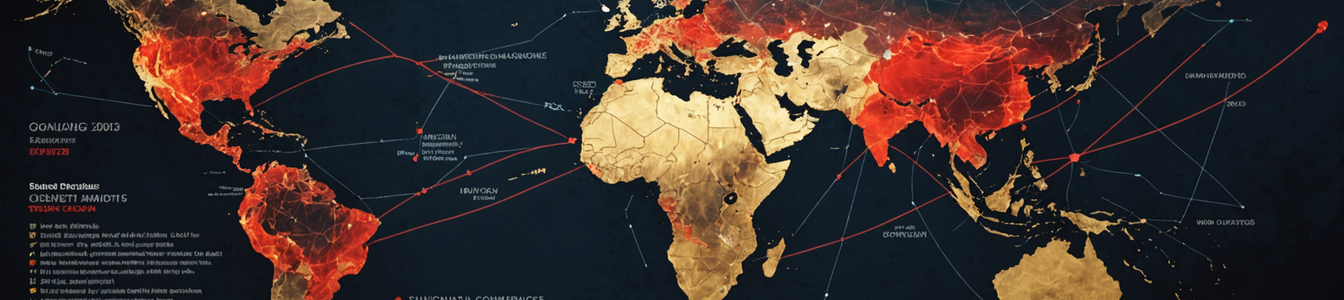
The landscape of international sanctions and compliance is undergoing a seismic shift. Two recent developments—China's outright prohibition on its oil companies complying with U.S. sanctions and Spain's demand for Israel to release a detained activist—underscore a growing trend of nations openly defying or challenging established enforcement mechanisms. For cybersecurity and compliance professionals, these events signal a new era of geopolitical risk where traditional frameworks are being tested, and the boundaries of jurisdiction are becoming increasingly blurred.
China's Ministry of Commerce has issued a directive prohibiting domestic oil companies from enforcing U.S. sanctions, particularly those targeting entities linked to Iran. This move directly counters Washington's extraterritorial application of its sanctions regime, which has long sought to penalize companies doing business with sanctioned nations. The Chinese government argues that such sanctions violate international law and infringe on national sovereignty. For multinational corporations, this creates a compliance paradox: adhering to U.S. sanctions could mean violating Chinese law, and vice versa.
The implications for cybersecurity are profound. Sanctions enforcement increasingly relies on digital surveillance, financial tracking, and data sharing. As nations assert their own legal frameworks, the risk of conflicting requirements grows. Compliance teams must now navigate a minefield where a single transaction could trigger penalties from multiple jurisdictions. The Chinese directive explicitly warns against compliance with 'foreign sanctions,' raising the stakes for companies with operations in both the U.S. and China.
Simultaneously, Spain's demand for the release of an activist detained by Israel highlights another dimension of this trend. Spain, a European Union member, is challenging Israel's detention practices, arguing they violate international humanitarian law. This case tests the limits of the International Criminal Court (ICC) and other multilateral bodies. For cybersecurity professionals, this underscores the importance of monitoring geopolitical tensions that can rapidly escalate into compliance crises.
The convergence of these events reveals a fragmented global order where traditional enforcement mechanisms—whether U.S. sanctions or international legal frameworks—are being openly contested. This creates new vulnerabilities for organizations that rely on clear, predictable compliance regimes. The rise of 'sanctions shopping'—where entities choose which jurisdiction's rules to follow—poses risks for financial systems, supply chains, and data flows.
From a cybersecurity perspective, the increasing politicization of sanctions enforcement introduces new attack vectors. State-sponsored actors may exploit legal gray areas to conduct espionage or disrupt critical infrastructure. The Chinese directive, for instance, could embolden cyber operations targeting U.S. sanctions monitoring systems. Similarly, Spain's challenge to Israel could inspire hacktivist groups to target both nations' digital assets.
For compliance professionals, the key takeaway is the need for agility. Traditional compliance frameworks, built around binary adherence to U.S. or EU sanctions, are no longer sufficient. Organizations must adopt a multi-jurisdictional approach, investing in real-time monitoring of legal developments across multiple regions. This includes leveraging artificial intelligence to track regulatory changes and assess risk exposure dynamically.
The broader trend also highlights the erosion of multilateralism. As nations prioritize national interests over collective enforcement, the role of international bodies like the United Nations and the ICC diminishes. This creates a vacuum where unilateral actions—whether by the U.S., China, or Israel—become the norm. For cybersecurity teams, this means preparing for a world where legal protections are inconsistent, and digital borders are increasingly fortified.
In conclusion, the defiance of sanctions by China and the challenge to Israel by Spain are not isolated incidents. They represent a structural shift in global governance. For the cybersecurity community, the message is clear: the rules are changing, and the risks are multiplying. Proactive adaptation, cross-border collaboration, and technological innovation will be essential to navigating this new compliance landscape.
Comentarios 0
Comentando como:
¡Únete a la conversación!
Sé el primero en compartir tu opinión sobre este artículo.
¡Inicia la conversación!
Sé el primero en comentar este artículo.