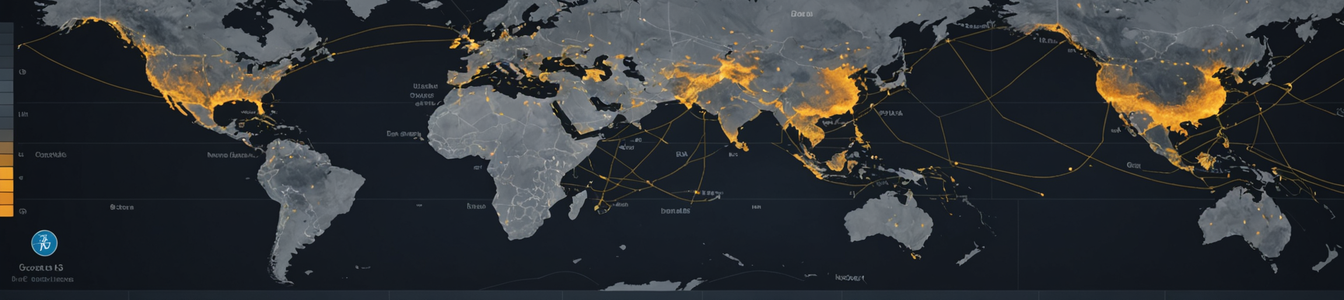
Security Operations Centers (SOCs) are traditionally architected to defend against known threat actors and predictable attack patterns. However, the current geopolitical climate is generating shockwaves that defy conventional models, creating systemic blind spots where rapid economic shifts and policy enforcement collide. The professional threat intelligence community must now account for a new calculus where trade imbalances, commodity spikes, and sanction regimes are not just background noise, but primary indicators of imminent cyber risk.
The Economic Warfare Front: Surpluses as Cyber War Chests
The starkest signal comes from macroeconomic data. China concluded 2025 with a monumental $1.2 trillion trade surplus, a figure that underscores its dominant position in global manufacturing and exports. This financial reservoir is not merely a statistic; it represents a profound strategic capacity. Analysts observe that Beijing is increasingly leveraging this economic heft for geopolitical ends, notably by imposing high-tech export curbs targeting US industries. This move from trade competition to targeted technological containment marks a significant escalation. For SOCs, the implication is clear: nations with significant financial surpluses and strategic grievances possess enhanced resources to fund sustained, sophisticated cyber campaigns. These can range from intellectual property theft to critical infrastructure probing, all underwritten by vast foreign exchange reserves.
This dynamic is not isolated to Asia. Russia's international reserves have also soared to historic highs, as reported by Sputnik. Despite extensive sanctions, alternative financial channels and robust energy exports have fortified its economic defenses. This financial resilience directly translates to cyber resilience and offensive capability. State-sponsored Advanced Persistent Threat (APT) groups require stable funding for infrastructure, talent, and research. Ballooning national reserves provide that cushion, enabling longer-term, more ambitious operations that can patiently evade traditional SOC detection cycles focused on more immediate, criminally-motivated threats.
The Commodity Flashpoint: Resource Tensions and Supply Chain Sabotage
Parallel to these financial shifts, volatility in commodity markets is creating another vector of instability. The price of silver has breached the $90 mark for the first time, driven by rate cut expectations but, more critically, by acute supply concerns. Precious and industrial metals are the lifeblood of the technology sector, essential for everything from semiconductors to renewable energy infrastructure. Price spikes and supply constraints incentivize malicious activity across the entire logistics chain. SOCs must now monitor for cyber threats aimed at mining operations, shipping logistics, and commodity exchanges—sectors that may have previously resided outside their core purview.
The threat extends to energy. With tensions flaring in Venezuela and Iran, analysts predict powerful increases in gasoline and diesel prices globally. Energy market shocks have a cascading effect on global stability, often serving as a catalyst for increased cyber aggression. Adversary nations may seek to leverage cyber means to exacerbate price volatility for political gain, targeting oil and gas infrastructure, pipeline control systems, or trading platforms. Furthermore, organizations facing sudden spikes in operational costs due to fuel prices may be forced to cut cybersecurity budgets, creating a double vulnerability: a more attractive target and a weakened defense.
The Geopolitical Kindling: Territorial and Alliance Stresses
Disputes like the rising tensions between the US and Denmark over Greenland add another layer of complexity. While seemingly distant from cyberspace, such geopolitical friction often spills over into the digital domain. They can trigger hacktivist campaigns, inspire insider threats within multinational organizations caught in the crossfire, or lead to the imposition of new, hastily-enforced sanctions regimes. Each new sanction package creates a compliance nightmare, forcing global SOCs to instantly update rules for transaction monitoring, communication intercepts, and insider threat detection related to newly blacklisted entities—often with incomplete and lagging data.
Operational Impact: The SOC Blind Spots
For the frontline security analyst, these converging trends manifest as critical blind spots:
- The Supply Chain Black Box: Increased targeting of commodity and tech supply chains introduces risk from third and fourth-party vendors that are rarely visible to traditional security tools. An attack on a minor supplier of rare-earth minerals can cripple a major tech manufacturer.
- The Policy-Triggered Alert Storm: Sudden sanctions or export controls can trigger a flood of alerts related to blocked entities, overwhelming analysts and causing true threats to be missed amidst the noise of compliance violations.
- The Motive Mismatch: SOC playbooks often focus on financial crime or espionage. Campaigns motivated by geopolitical commodity manipulation or economic warfare may exhibit different Tactics, Techniques, and Procedures (TTPs), flying under the radar of rules tuned for other motives.
- Resource Reallocation Strain: As business units scramble to adapt to new trade rules or find alternative suppliers due to sanctions, they may spin up new, poorly secured digital infrastructure (shadow IT) outside the SOC's visibility.
Mitigation Strategies for a New Era
To adapt, SOCs must integrate geopolitical and economic intelligence into their core threat models. This involves:
- Establishing a Geopolitical Watch: Dedicate analyst time or leverage specialized feeds to monitor for events like major trade announcements, commodity price shocks, and sanctions updates.
- Mapping the Extended Supply Chain: Work with procurement to identify critical dependencies on geopolitical hotspots for resources and technology, and conduct targeted risk assessments on those nodes.
- Developing Agile Playbooks: Create incident response and monitoring playbooks that can be quickly activated in response to specific geopolitical events (e.g., "Sanctions against Country X" playbook).
- Enhancing Financial Flow Monitoring: Collaborate with finance and compliance teams to better correlate unusual network activity with transactions involving high-risk jurisdictions or sectors under tension.
The era where geopolitics was a concern only for the C-suite is over. Today, a trade surplus report or a commodity price alert is a legitimate threat indicator. SOCs that fail to connect these macroeconomic dots will find themselves defending yesterday's battles while adversaries exploit the vulnerabilities born from today's economic shocks.
Comentarios 0
Comentando como:
¡Únete a la conversación!
Sé el primero en compartir tu opinión sobre este artículo.
¡Inicia la conversación!
Sé el primero en comentar este artículo.