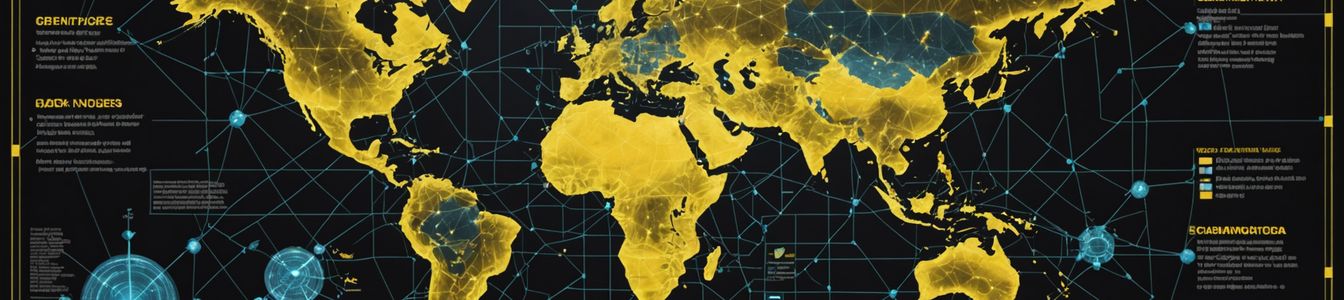
The landscape of international power is undergoing a fundamental transformation. No longer confined to traditional military might or economic size, national security is increasingly defined by control over critical resources and the technological infrastructure that processes them. This shift is creating a new paradigm of "resource diplomacy," where semiconductors, uranium, and crude oil have become the primary currencies of geopolitical influence, with cybersecurity serving as both the shield and the battleground for this new competition.
At the heart of this transformation lies the semiconductor industry. The recent case of Nvidia's H200 chip sales to China exemplifies the new rules of engagement. Despite receiving what was reported as a go-ahead in December, the final approval is now stalled, awaiting a strategic review by the U.S. State Department. This is not merely a bureaucratic delay; it represents a conscious weaponization of technology export controls. Advanced chips like the H200 are dual-use technologies, powering everything from consumer AI applications to sophisticated military simulations and cryptographic systems. By controlling their flow, a nation can directly influence the cybersecurity capabilities—and vulnerabilities—of its rivals. This creates a direct link between supply chain integrity and national cyber sovereignty, where a single component can become a strategic chokepoint.
Parallel to the chip wars, the energy sector is witnessing a similar realignment of power dynamics. India's pursuit of a monumental $3 billion uranium supply deal with Canada is a strategic move to secure its nuclear energy future and reduce dependency on unpredictable suppliers. Nuclear energy infrastructure is among the most sensitive from a cybersecurity perspective, with its operational technology (OT) networks representing high-value targets for state-sponsored actors. A stable, diplomatically-secured fuel supply is the first layer of defense, reducing the geopolitical leverage that could be used to coerce a nation or disrupt its critical energy grid.
Furthermore, India's exploration of a strategic pivot from Russian to Venezuelan crude oil, a move analysts suggest could yield $3 billion in savings, is another facet of this resource diplomacy. Energy supply chains are notoriously vulnerable to cyber-physical attacks, as seen in the Colonial Pipeline incident. Diversifying suppliers isn't just an economic calculation; it's a cybersecurity imperative. Each new supplier relationship introduces a different set of digital infrastructure, standards, and potential threat vectors. National cybersecurity postures must now account for the digital trustworthiness of every link in the energy supply chain, from the oil field's SCADA systems to the shipping logistics and refinery controls.
These maneuvers are not happening in isolation. They are part of a broader diplomatic chessboard, as indicated by reports of an upcoming visit by Indian Prime Minister Narendra Modi to Israel. Such high-level engagements often include significant discussions on technology transfer, critical infrastructure protection, and joint cybersecurity initiatives. Alliances are no longer just military or economic; they are increasingly technological and cyber-centric, built around shared dependencies on secure resources.
The market is responding to this pressure for technological sovereignty. Intel's declaration of its intent to compete directly with Nvidia in the GPU market is a significant development. For decades, the concentration of advanced chip design and manufacturing in a few corporate and geographic centers created systemic risk. The entry of a giant like Intel, with its vast fabrication capabilities, into the high-performance GPU space offers nations an alternative supply chain—a potential lifeline for their AI ambitions and, by extension, their next-generation cybersecurity tools, which are increasingly AI-dependent. A more diversified semiconductor ecosystem inherently strengthens global supply chain resilience against both physical disruption and cyber sabotage.
Implications for Cybersecurity Professionals and National Strategy
For the cybersecurity community, this new era demands a radical expansion of scope. Risk assessments must now incorporate geopolitical analysis of resource dependencies. Security-by-design principles need to be enforced not just in software, but in the very hardware that underpins national infrastructure, with greater emphasis on hardware security modules (HSMs), secure boot processes, and supply chain provenance verification.
National strategies must evolve to create "cyber-sanctuaries" around critical resource networks. This involves:
- Enhanced OT/IoT Security: Fortifying the often-neglected operational technology that controls energy plants, chip fabrication facilities, and mining operations.
- Diplomatic Cyber Clauses: Integrating cybersecurity standards and mutual assistance protocols directly into trade deals for critical resources.
- Sovereign Technology Stacks: Investing in domestic or allied-capacity for critical technologies, reducing single points of failure that can be exploited through cyber means.
- Intelligence-Led Defense: Aligning cyber threat intelligence more closely with geopolitical and economic intelligence to anticipate attacks aimed at resource chokepoints.
In conclusion, the lines between diplomacy, trade, and cybersecurity have blurred beyond recognition. A uranium deal, a chip export license, and an oil contract are no longer just commercial transactions; they are foundational elements of a nation's cyber defense posture. In this world, energy security is cybersecurity, and technological sovereignty is national sovereignty. The nations that successfully navigate this complex web of resource dependencies, while hardening the digital infrastructure that manages them, will define the security paradigm of the 21st century.
Comentarios 0
Comentando como:
¡Únete a la conversación!
Sé el primero en compartir tu opinión sobre este artículo.
¡Inicia la conversación!
Sé el primero en comentar este artículo.