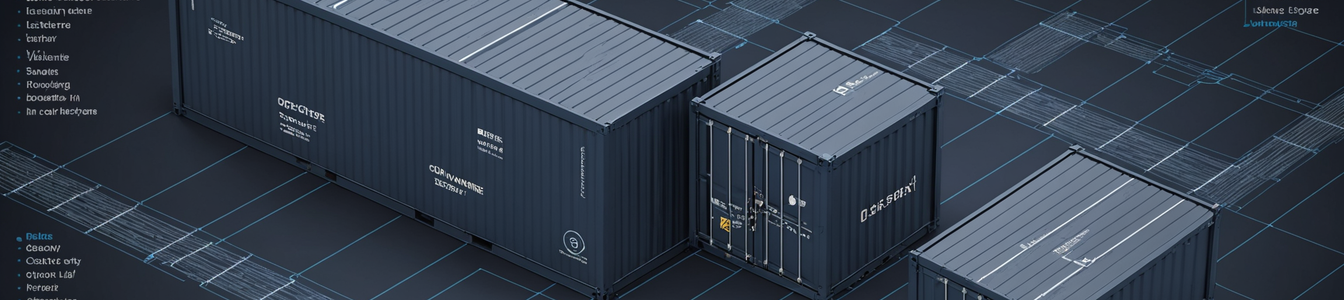
The containerization revolution, once hailed as a unifying force for application deployment, is at a security crossroads. What began as a standardized approach to packaging and running software is now fragmenting into two distinct evolutionary paths: massive, physical containerized data centers at the infrastructure layer, and increasingly sophisticated, security-focused developer tools at the desktop layer. This divergence is not merely technological but is creating a sprawling and complex attack surface that challenges traditional cybersecurity paradigms.
The Infrastructure Challenge: Containerized Data Centers Hitting Limits
On the macro scale, the market for containerized data centers—prefabricated, modular units housing complete computing infrastructure—continues to grow, particularly in North America. These solutions offer rapid deployment and scalability for enterprises. However, they are confronting a significant technical hurdle: limited rack density. As artificial intelligence and machine learning workloads become ubiquitous, their demand for high-performance computing (HPC) resources, specialized hardware like GPUs, and immense power and cooling exceeds the design constraints of many current containerized data center models.
This creates a cascading security impact. When infrastructure cannot efficiently support the workloads it hosts, organizations may resort to risky workarounds. Overprovisioning virtual resources on limited physical hardware can lead to noisy neighbor problems and unpredictable performance, complicating intrusion detection and anomaly monitoring. Furthermore, the push to cram more power into a confined space can strain thermal management, increasing hardware failure rates—a reliability issue that directly affects security availability. For cybersecurity teams, this means the underlying infrastructure supporting their containerized applications may be operating under performance stress, creating blind spots where security monitoring tools themselves could falter.
The Developer Evolution: Podman and the Shift to Rootless Security
Parallel to this infrastructure narrative, a quiet revolution is occurring at the developer's desktop. Tools like Podman are emerging as compelling alternatives to the long-dominant Docker, specifically by solving architectural security concerns that many teams didn't fully articulate until faced with them.
Podman's fundamental security advantage lies in its daemonless and rootless architecture. Unlike Docker, which relies on a central, always-running daemon (often with root privileges), Podman launches containers directly via a fork/exec model. This eliminates the single point of failure and privilege escalation risk inherent in a central daemon. The ability to run containers rootlessly—where the container process runs under the user's own ID rather than the system's root—dramatically reduces the blast radius of a container breakout. If a vulnerability in a rootless container is exploited, the attacker gains only the privileges of the user who launched it, not of the entire host system.
For security practitioners, this represents a profound shift in the default security posture of the development toolchain. It embeds the principle of least privilege directly into the developer workflow, moving security left in the CI/CD pipeline. However, it also introduces complexity: security policies and compliance checks must now account for two different runtime architectures (daemon-based vs. daemonless) and different user namespace mappings.
The Fragmentation Problem: A Security Governance Nightmare
This is where the core security challenge emerges. The ecosystem is splitting. In the data center, we have large, physical containers housing entire server racks, managed by facilities and infrastructure teams. On the developer laptop, we have lightweight, secure tooling like Podman, managed by engineering teams. The security models, operational procedures, and monitoring tools for these two worlds are increasingly dissimilar.
This fragmentation threatens holistic security governance. How does a CISO enforce a unified container security policy when the runtime environment in production (often still orchestrated by Kubernetes using various runtimes) is fundamentally different from the environment used for development and testing? Vulnerability management becomes more complex when images built and tested in a rootless Podman environment behave differently when deployed to a high-density, potentially resource-constrained containerized data center running a different runtime.
Network security policies, secrets management, and runtime defense tools (like eBPF-based security agents) must be validated across this fragmented stack. The risk is a security gap emerging between development and production, or between the understanding of the infrastructure team and the application team.
Navigating the Crossroads: Strategies for Security Teams
To secure this bifurcated future, cybersecurity professionals must adopt integrated strategies:
- Policy as Unified Code: Implement security policies—for image signing, vulnerability scanning, and runtime behavior—as code that can be applied consistently across both developer tools (Podman, Docker) and production orchestrators (Kubernetes), regardless of the underlying infrastructure.
- Supply Chain Vigilance: The container supply chain remains the critical attack vector. Security must focus on securing build pipelines, mandating signed images, and scanning for vulnerabilities at every stage, from the developer's desktop to the containerized data center rack.
- Runtime Security Adaptation: Invest in runtime security solutions that are agnostic to the container runtime (containerd, CRI-O, Podman) and can function effectively in both high-density data center environments and cloud-native deployments. Agentless or eBPF-based approaches are gaining favor for their lower overhead.
- Education and Collaboration: Bridge the gap between infrastructure/ops teams managing the physical container environments and developer teams adopting tools like Podman. Joint training on the security implications of both domains is essential.
Conclusion
The promise of containerization was simplicity and consistency. The reality is a landscape of powerful specialization, which brings both benefits and risks. The limitations of containerized data centers for next-gen workloads and the rise of secure-by-design developer tools like Podman are not isolated trends. They are two sides of the same coin, reflecting an ecosystem maturing—and splitting—under pressure. For cybersecurity, the task is no longer just to secure containers, but to secure the increasingly complex and fragmented world that the container revolution has created. Success will depend on creating security frameworks that are as flexible and adaptable as the container technologies they are designed to protect.
Comentarios 0
Comentando como:
¡Únete a la conversación!
Sé el primero en compartir tu opinión sobre este artículo.
¡Inicia la conversación!
Sé el primero en comentar este artículo.