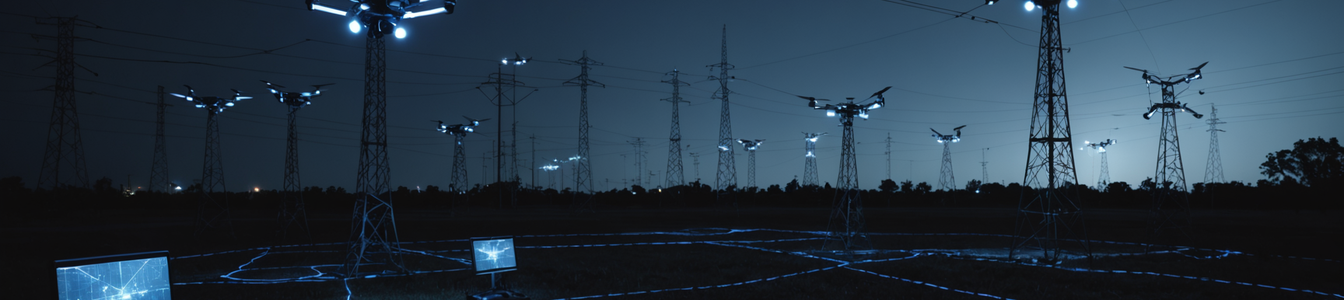
A groundbreaking security simulation has exposed what experts are calling the "Achilles' heel" of U.S. critical infrastructure: the power grid's vulnerability to coordinated drone attacks. The exercise, conducted by security researchers and infrastructure specialists, revealed how relatively inexpensive commercial drones could be weaponized to cause widespread blackouts and potentially cripple regional energy networks for extended periods.
The simulation focused on key electrical substations, which serve as critical nodes in the national grid. Researchers demonstrated how drones equipped with simple payloads—ranging from conductive materials to short-range electromagnetic pulse devices—could disable transformers, circuit breakers, and control systems. Unlike traditional physical attacks requiring proximity and significant resources, drone-based assaults could be launched from miles away with minimal risk to operators.
"What makes this particularly concerning is the asymmetry," explained Dr. Elena Rodriguez, a critical infrastructure security analyst who participated in the simulation. "For a few thousand dollars in drone technology, malicious actors could potentially cause billions in economic damage and endanger public safety. The barrier to entry is dangerously low while the potential impact is catastrophically high."
The simulation's findings gain additional urgency when viewed alongside Europe's recent energy security challenges. Over the past four years, European nations have endured three major energy shocks: supply disruptions from geopolitical conflicts, cyberattacks on energy infrastructure, and market volatility from over-reliance on external suppliers. These events have demonstrated how energy systems can become strategic targets in geopolitical conflicts and how vulnerabilities in one sector can cascade across entire economies.
Technical analysis from the simulation identified several specific vulnerabilities. Most substations lack adequate drone detection capabilities, with existing security focused primarily on ground-based perimeter defense. Many critical components remain exposed rather than housed in hardened enclosures. Communication systems between substations often lack sufficient encryption and could be jammed or spoofed during an attack, preventing coordinated response.
Regulatory gaps compound these technical vulnerabilities. Current Federal Aviation Administration (FAA) regulations focus primarily on airspace safety rather than security threats from unmanned aerial systems. While the Department of Energy has established cybersecurity standards for the grid through initiatives like the Electricity Subsector Cybersecurity Capability Maturity Model (ES-C2M2), physical security against drone threats remains largely unaddressed in mandatory frameworks.
The simulation tested various attack scenarios, with the most effective involving coordinated swarms targeting multiple substations simultaneously. Such an attack could overwhelm response capabilities and create cascading failures that manual operators would struggle to contain. Recovery times for damaged high-voltage transformers—some of which have lead times of 12-18 months for replacement—could extend blackouts from days to months in worst-case scenarios.
Industry response has been mixed. Some utility companies have begun investing in counter-drone technology, including radio frequency detectors, radar systems, and directed energy weapons for disabling unauthorized drones. However, these systems remain expensive and face regulatory hurdles regarding their deployment in civilian airspace.
"We're playing catch-up," acknowledged Michael Chen, security director for a major northeastern utility. "Our security paradigms were built around preventing physical access by individuals. We need to completely rethink our approach for threats that can fly over fences and bypass traditional security measures."
Security experts recommend a multi-layered defense strategy beginning with comprehensive risk assessments specific to drone threats. This should be followed by investment in detection systems capable of identifying drones at sufficient range to allow for intervention. Physical hardening of critical components, including shielding and enclosures resistant to various payload types, represents another crucial layer.
Policy recommendations emerging from the simulation include updating the National Infrastructure Protection Plan to specifically address drone threats, establishing no-fly zones around critical infrastructure with enhanced enforcement capabilities, and creating information-sharing mechanisms between utilities, law enforcement, and intelligence agencies regarding drone threat intelligence.
The geopolitical dimension cannot be ignored. As state-sponsored groups increasingly engage in gray-zone conflict below the threshold of conventional warfare, critical infrastructure becomes an attractive target. The simulation's participants noted that nations facing energy independence challenges—like Europe's experience with supply shocks—become particularly vulnerable to such asymmetric attacks aimed at exacerbating existing weaknesses.
Looking forward, the integration of artificial intelligence and machine learning into both attack and defense scenarios presents additional challenges. Autonomous drone swarms could potentially identify and exploit vulnerabilities without direct human control, while AI-powered defense systems will be necessary to respond at machine speeds.
For cybersecurity professionals, the implications extend beyond traditional digital domains. The convergence of physical and cyber threats requires developing expertise in operational technology security, understanding industrial control systems, and collaborating with physical security teams. The simulation serves as a stark reminder that in an interconnected world, vulnerabilities in one domain can have cascading effects across multiple sectors, making comprehensive, defense-in-depth approaches more critical than ever.
The time for action is now, experts agree. As drone technology becomes more sophisticated and accessible, the window for implementing effective defenses is closing. Protecting the grid requires not just technological solutions but also regulatory updates, industry collaboration, and a fundamental shift in how we conceptualize infrastructure security in an age of airborne threats.
Comentarios 0
Comentando como:
¡Únete a la conversación!
Sé el primero en compartir tu opinión sobre este artículo.
¡Inicia la conversación!
Sé el primero en comentar este artículo.