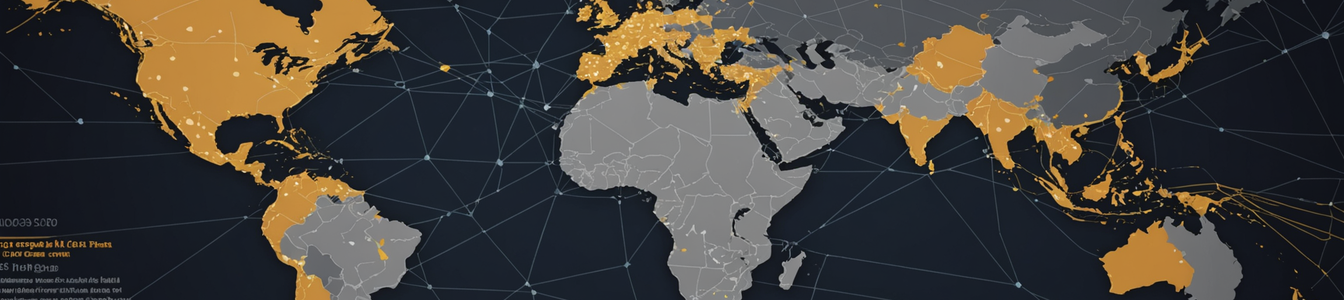
The specter of conflict in the Middle East, particularly involving Iran, has transcended the traditional battlefield, exposing critical fault lines in the very architecture of the globalized world. For cybersecurity leaders, this represents a pivotal moment: the attack surface has expanded from servers and endpoints to encompass entire economic and social systems. The vulnerabilities being exploited are not zero-days in software, but zero-days in globalization itself—systemic weaknesses in just-in-time supply chains, concentrated energy dependencies, and deeply intertwined financial markets.
The Cascade Effect: From Local Conflict to Global Systemic Shock
Modern warfare is no longer confined to physical borders. A strike on a key logistical hub or energy facility in the Strait of Hormuz triggers an immediate, automated cascade. Algorithmic trading reacts to news headlines, triggering volatility. Shipping insurance premiums skyrocket, rerouting global logistics. Energy spot prices spike, impacting manufacturing costs worldwide. This digital-physical feedback loop, mediated by real-time data flows and automated decision-making systems, amplifies localized events into global crises with unprecedented speed. The cybersecurity implication is clear: threat modeling must now include geopolitical event trees and their potential to trigger automated financial and logistical responses that can cripple an organization indirectly.
Energy as a Weaponized Dependency: The New Digital Battlefield
The conflict has starkly highlighted energy dependence not merely as an economic concern, but as a profound national security and cyber resilience issue. Price shocks and supply constraints act as force multipliers for other attacks, straining the resources and attention of security teams while critical infrastructure operators are pushed to their limits. Furthermore, the urgent "reignition" of the energy transition, as nations scramble for alternatives, creates its own set of vulnerabilities. The rapid deployment of smart grids, distributed renewable resources, and IoT-enabled energy management systems expands the attack surface for critical infrastructure. Adversaries may target this period of transition and adaptation, seeking to sabotage emerging energy networks or exploit the integration challenges between legacy and new systems.
The Weaponization of Interdependency: A Paradigm Shift for Security
This is the era of weaponized interdependency. Adversaries, both state and non-state, now understand that disrupting a single, concentrated node in the global network—be it a semiconductor fabricator in Taiwan, a gas pipeline, or a major port—can inflict disproportionate economic damage. This strategy bypasses traditional military defenses and, often, direct cyber defenses of the ultimate target. The attack is levied on the ecosystem. For Chief Information Security Officers (CISOs), this necessitates a radical expansion of scope. Third-party and fourth-party risk management is no longer a compliance exercise; it is a core survival function. Understanding the geopolitical exposure of key suppliers, the resilience of logistics partners, and the energy profile of primary data centers becomes as important as patching critical vulnerabilities.
Strategic Recommendations for Cyber Defense in an Age of Systemic Risk
- Integrate Geopolitical Intelligence into Threat Intelligence Platforms (TIPs): Security operations centers (SOCs) must feed on data beyond malware hashes and IP reputations. Indicators of Compromise (IOCs) must be supplemented by Indicators of Systemic Risk (IOSRs)—data points on regional stability, commodity prices, and supply chain congestion.
- Model Economic Shock Scenarios: Conduct tabletop exercises that simulate not just a ransomware attack, but a scenario where a geopolitical event causes a 300% spike in energy costs or a six-month delay in critical hardware components. How does the security program adapt? How are operations maintained?
- Architect for Resilience, Not Just Protection: Move beyond redundancy to true resilience. This includes diversifying cloud regions, considering sovereign data solutions, investing in energy resiliency for core facilities (e.g., on-site generation), and developing manual or low-tech operational fallbacks for critical processes.
- Advocate for a Broader Security Mandate: CISOs must elevate their role to that of a systemic risk officer. This involves communicating to boards and executives in terms of business continuity, economic exposure, and brand resilience in the face of global shocks, linking technical capabilities directly to these strategic outcomes.
The conflict illuminates a fundamental truth: the most dangerous vulnerabilities are often the ones we have willingly built into our systems for the sake of efficiency and growth. Cybersecurity's next frontier is not just defending the code we write, but understanding and securing the complex, fragile systems within which that code operates. The mandate has expanded from protecting information to safeguarding the continuity of society itself in an interconnected age.
Comentarios 0
Comentando como:
¡Únete a la conversación!
Sé el primero en compartir tu opinión sobre este artículo.
¡Inicia la conversación!
Sé el primero en comentar este artículo.