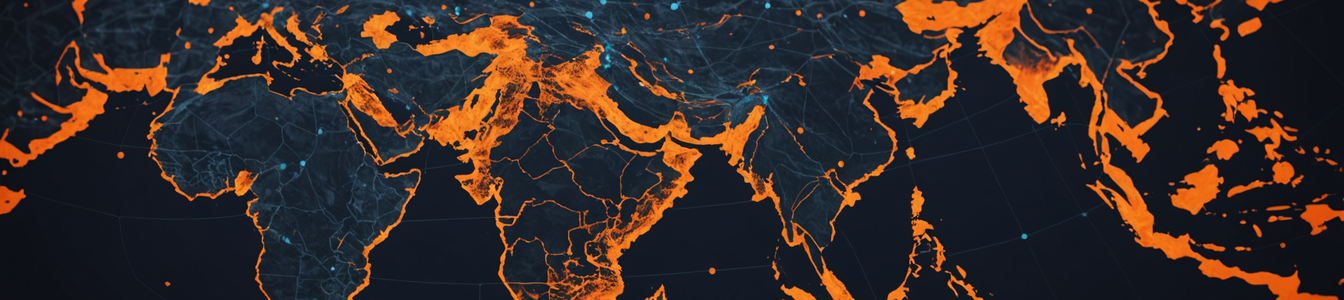
The digital transformation of India's economy, while driving unprecedented financial inclusion, has inadvertently charted a map for a parallel, shadow economy of fraud. Recent data paints a disturbing picture of geographic concentration, where specific Indian states have evolved into billion-dollar epicenters for financial cybercrime, resulting in catastrophic losses for citizens and a complex challenge for cybersecurity defenders.
The Staggering Scale and Geographic Fault Lines
Over the past six years, reported financial fraud and cheating cases in India have led to a collective loss exceeding ₹53,000 crore (roughly $6.4 billion). This figure, vast as it is, likely represents only the visible tip of the iceberg, with many scams going unreported due to shame, complexity, or lack of faith in recovery. The distribution of these losses is not uniform across the nation's 28 states and 8 union territories. Instead, it reveals stark fault lines.
Maharashtra, India's financial and industrial powerhouse, stands as the worst-hit region. Its status as a prime target is multifaceted: it hosts the highest concentration of corporate headquarters and wealthy individuals (prime targets for 'whaling' attacks), has a vast and diverse population with varying levels of digital literacy, and serves as a central hub for financial transactions. Other states with high economic activity, such as Delhi, Karnataka, and Telangana, also feature prominently on this grim map, suggesting a direct correlation between economic density and fraud volume.
Beyond Mass Phishing: The Rise of Sophisticated, Regional Social Engineering
The nature of attacks driving these losses has evolved significantly. The era of generic, mass-emailed phishing lures is giving way to highly targeted campaigns that exploit regional specifics. This aligns with the global cybersecurity distinction between broad phishing and its more dangerous cousins: spear-phishing and whaling.
- Spear-Phishing (Ataque Direcionado): In the Indian context, this translates to scams meticulously crafted for residents of a particular state. Attackers use local dialects, reference state-specific government schemes (e.g., farm loan waivers, housing subsidies), or impersonate regional banks and cooperatives. A fraudulent message in Marathi about a "Maharashtra Government Solar Subsidy" will have a far higher success rate in Pune than a generic English email.
- Whaling (Ataque à Baleia): This refers to targeting high-value individuals—CEOs, senior officials, wealthy businesspersons. States like Maharashtra, with a dense population of such "whales," see advanced attacks involving deepfake audio/video, compromised business email (BEC) schemes targeting large wire transfers, and intelligence gathered from social media and local news about corporate deals or personal events.
These are not mere digital crimes; they are socio-technical exploits. Fraudsters study regional news for disasters or policy announcements, leverage festivals and local customs to create urgency, and understand which digital payment apps (UPI, Paytm, etc.) are most trusted in which region before crafting their deception.
The Cybersecurity Imperative: Hyper-Localized Defense
For cybersecurity professionals, both within India and globally observing this trend, the response must move beyond one-size-fits-all solutions. The mapping of fraud epicenters mandates a hyper-localized defense strategy.
- Regional Threat Intelligence: Security operations centers (SOCs) and threat intelligence firms must develop feeds that track scams emerging from and targeting specific Indian states. Understanding the "signature" of a Gujarat-based tech support scam versus a Punjab-based romance scam is crucial for effective filtering and alerting.
- Culturally-Aware Awareness Training: Corporate and public awareness campaigns cannot be solely in English or Hindi. They must be translated and, more importantly, contextualized into regional languages, using examples relevant to that state's population and common scam vectors.
- Collaboration with Local Authorities: Fighting cross-border cybercrime requires deep collaboration between national agencies and state police cyber cells. The localized knowledge of state police is invaluable for tracking the on-ground networks—money mules, call center locations—that enable these digital frauds.
- Vendor and Supply Chain Risk: Multinational companies with operations or vendors in high-fraud states must incorporate this geographic risk into their third-party risk assessments. An accounts payable department in a Mumbai-based vendor is a high-value target for BEC fraud.
Conclusion: A New Geography of Risk
The concentration of fraud in India's "Billion-Dollar Scam States" like Maharashtra reveals a new geography of cyber risk. It is a geography defined not by national borders, but by economic activity, digital adoption gaps, linguistic diversity, and regional trust models. For fraudsters, these states are not just administrative zones; they are target-rich environments with unique vulnerabilities to exploit. For the cybersecurity community, this map is a call to action. It demands that we layer our technical defenses with anthropological insight, complement our global threat feeds with local intelligence, and recognize that to protect digital assets in the 21st century, we must first understand the very human, very local landscapes in which they reside. The battle against financial cybercrime is increasingly being fought at the state and district level, and our defenses must descend to that same granularity.
Comentarios 0
Comentando como:
¡Únete a la conversación!
Sé el primero en compartir tu opinión sobre este artículo.
¡Inicia la conversación!
Sé el primero en comentar este artículo.