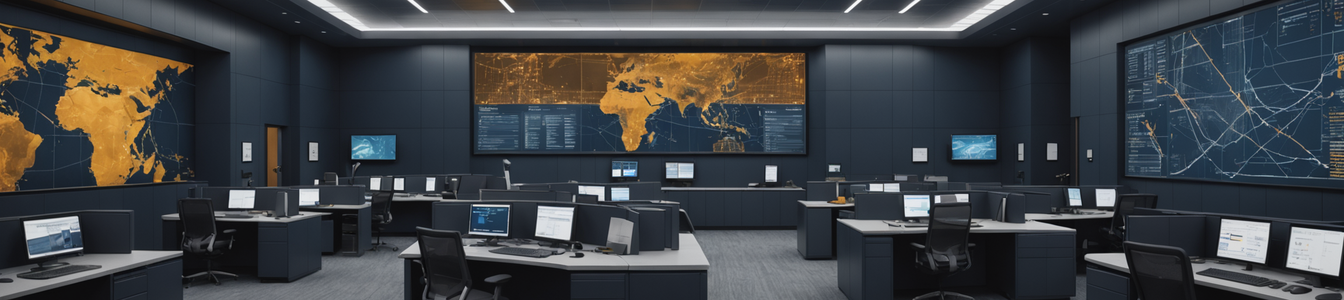
India's Seva Teerth: A Cybersecurity Paradigm Shift in National Command
On a landmark day for India's administrative architecture, Prime Minister Narendra Modi inaugurated the 'Seva Teerth' complex on Kartavya Path, New Delhi. This event marks the definitive relocation of the Prime Minister's Office (PMO) from its historic seat in the South Block—a symbol of British colonial administration—to a modern, integrated facility designed for 21st-century governance. Beyond the symbolic break from the past, Seva Teerth represents a profound operational shift: it now centrally houses the PMO, the National Security Council Secretariat (NSCS), and the Cabinet Secretariat. For the global cybersecurity community, this consolidation of India's apex strategic command into a single physical and digital ecosystem is a development of critical importance, redefining the nation's threat surface and defensive posture.
From Colonial Silos to Integrated Command
The previous dispersal of critical functions across the South and North Blocks, while historic, created inherent operational and security challenges. Communication between the PMO, NSCS, and Cabinet Secretariat often relied on physical document movement and segmented digital networks, introducing latency and potential vulnerabilities. Seva Teerth is engineered to dissolve these silos. The co-location of these entities facilitates instantaneous, secure communication and decision-making loops, crucial during national security crises, including cyber warfare incidents. The very design philosophy moves from compartmentalization to integration, a principle that must be mirrored and fortified in its cybersecurity architecture.
The Cybersecurity Calculus: Unprecedented Consolidation, Unprecedented Risk
From a security perspective, the move presents a classic risk-reward equation. On the reward side, a centralized facility allows for the implementation of a unified, state-of-the-art cybersecurity framework. Instead of managing three separate, legacy networks with varying security postures, the National Security Council Secretariat and the Indian Computer Emergency Response Team (CERT-In) can theoretically oversee a single, hardened digital perimeter. This enables consistent security policies, centralized monitoring via a Security Operations Center (SOC), and streamlined incident response. The physical proximity of cyber and national security decision-makers can drastically reduce the time between threat detection and strategic authorization for countermeasures.
Conversely, the risk is monumental. Seva Teerth instantly becomes one of the world's most attractive cyber-physical targets. A successful sophisticated cyber intrusion could, in theory, compromise the digital sanctity of the PMO, the nation's strategic security planning at the NSCS, and the entire cabinet's decision-making apparatus simultaneously. The threat model escalates from targeting individual entities to potentially crippling the core of the Indian state. This demands a defense-in-depth strategy of extraordinary rigor, likely involving air-gapped networks for the most sensitive communications, quantum-resilient encryption, zero-trust architecture that assumes breach, and physical security controls integrated with cyber threat detection.
Operational Tempo and Symbolic Significance
The significance of Seva Teerth was underscored immediately. On its first operational day, Prime Minister Modi chaired meetings and approved major financial initiatives, including the 'PM RAHAT' scheme and significant funds for agriculture and startups, signaling the complex is not just a shell but a fully functional command hub from day one. This rapid operationalization indicates that the underlying digital migration—arguably the most complex part of the move—was executed with meticulous planning. The seamless transition suggests a pre-existing, robust digital infrastructure was ready to support critical national functions without downtime, a non-negotiable requirement for national security continuity.
The move from the 'power corridors' of Lutyens' Delhi to the renamed 'Kartavya Path' (Path of Duty) is deeply symbolic. It represents a conscious shift from an architecture of imperial authority to one of public service and modern efficiency. In cybersecurity terms, this symbolism translates to a move away from potentially outdated, legacy systems embedded in old structures toward a purpose-built digital environment. This greenfield opportunity allows India to embed security-by-design principles from the ground up, avoiding the technical debt and patchwork security often found in upgraded legacy systems.
Implications for Global Security and Critical Infrastructure Governance
Seva Teerth sets a precedent for how major democracies conceptualize and secure their central nervous systems. It reflects a growing global recognition that national security in the digital age cannot be effectively managed from fragmented, historic buildings with technological limitations. The project will be closely studied by allied and adversarial nations alike. For allies, it represents a potential blueprint for secure, integrated command. For adversaries, it outlines a new attack surface and a testament to India's centralized digital fortification ambitions.
The success of this grand administrative and security experiment hinges almost entirely on its unseen cybersecurity foundations. The physical structure is merely the vessel; its resilience will be determined by the strength of its encryption, the acuity of its threat hunters, the redundancy of its networks, and the wisdom of its security protocols. As India's strategic command settles into its new home, the nation's cyber guardians face their most defining mandate: transforming Seva Teerth from a high-value target into an impregnable digital fortress, securing the heart of the world's largest democracy for the digital century ahead.
Comentarios 0
Comentando como:
¡Únete a la conversación!
Sé el primero en compartir tu opinión sobre este artículo.
¡Inicia la conversación!
Sé el primero en comentar este artículo.