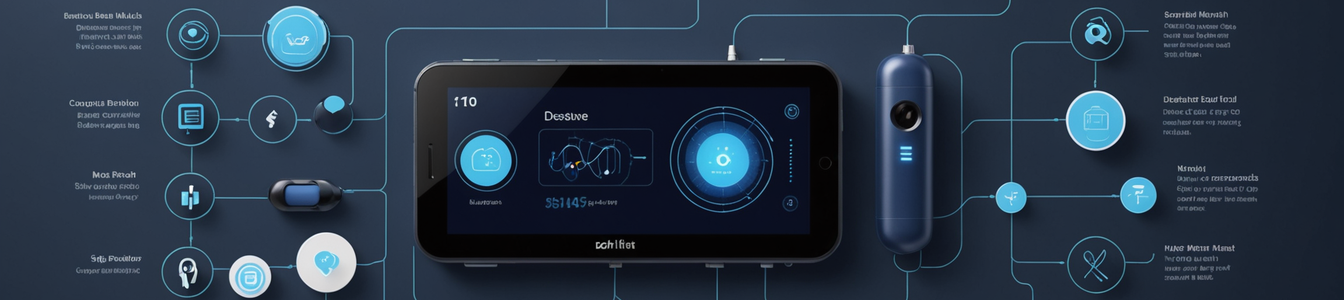
The Internet of Things (IoT) has long promised a safer, more responsive world. From smoke alarms that call the fire department to wearables that monitor heart rates, the integration of sensors into our daily lives has been a steady evolution. However, a new wave of sensor technology is pushing beyond monitoring our environment to analyzing the very substances we intend to ingest or that interact directly with our bodies. This shift from ambient to intimate sensing marks a pivotal moment for cybersecurity, creating a new frontier of personal safety hacking where the integrity of a sensor's reading can have immediate physical consequences. Two seemingly disparate trends—cutting-edge chemical detection and the enduring importance of basic home safety sensors—are converging to create a vastly expanded and critically vulnerable attack surface.
The Hyper-Personal Sensor: A Chemical Sentinel
The vanguard of this shift is exemplified by innovations like a recently developed sensor from Valencia, Spain. This device is designed for a deeply personal security scenario: detecting the presence of date-rape drugs or other dangerous substances in a beverage. Its operation is elegantly simple for the user—the more danger present, the brighter it glows. This immediate, analog-like feedback is a powerful safety feature. Technologically, it likely relies on specific chemical receptors or reactive compounds that undergo a photoluminescent change upon binding with target molecules like GHB or ketamine.
From a cybersecurity and privacy perspective, this introduces profound new challenges. First, the device generates a unique data stream: a binary or graded "safety score" of a consumable item directly linked to an individual. If this device is connected—or connectable in a future iteration—this data becomes a highly sensitive log of personal activity and potential vulnerability. Second, and more critically, is the threat of subversion. Could an attacker spoof the sensor's chemical reaction through a directed light source or electromagnetic interference to show a "safe" reading when danger is present? Conversely, could a denial-of-service attack, perhaps via jamming the sensor's frequency or corrupting its firmware, render it inert, providing a false sense of security? The trust model shifts from "is my network secure?" to "can I trust the fundamental physical reading of this device?"
The Foundational Layer: Unassuming Yet Critical IoT
Parallel to these novel devices, foundational smart home safety sensors remain persistently critical. As highlighted in ongoing smart home analyses, simple water leak sensors are consistently rated as one of the most vital and cost-effective IoT upgrades. These devices guard against physical infrastructure damage, mold, and financial loss. They represent the established, often overlooked, layer of safety IoT upon which newer, more personal layers are being built.
Their criticality makes them a prime target. A coordinated ransomware attack that disables water leak sensors across a smart home platform during a regional freeze could lead to catastrophic, widespread property damage. Spoofing a leak signal could trigger panic, automatic water shutoff, or unnecessary service calls. These sensors are nodes in an increasingly interdependent system; their compromise can have cascading physical effects.
The Converging Attack Surface: A Blueprint for Risk
The intersection of next-gen chemical IoT and foundational safety IoT creates a multi-layered risk landscape for cybersecurity professionals to address:
- Data Integrity & Sensor Spoofing: The core challenge is ensuring the authenticity of the sensor's physical reading. Cryptographic verification of the sensor node is just the first step. Security frameworks must evolve to include integrity checks for the sensor's analog function—detecting manipulation of its physical detection mechanism.
- Life-Critical Denial-of-Service: An attack that disables a water leak sensor is costly. An attack that disables a network of chemical threat sensors in a social venue is potentially lethal. The consequence calculus for DoS attacks on personal safety IoT is of a different magnitude, demanding resilient, offline-capable alerting mechanisms and robust, minimal-firmware designs.
- Privacy of Intimate Data: The data from a drink-spiking sensor is arguably more sensitive than location data. It indicates a specific personal action (consumption) in a specific context (a social setting), and its very existence in a log could imply a past threat or vulnerability. Data storage, transmission, and lifecycle policies for this class of data must be exceptionally stringent.
- Systemic Interdependence: Future smart safety ecosystems may link these sensors. A chemical threat sensor in a drink could trigger a personal alarm and log an incident to a home security system. This interconnectivity creates attack pivots, where a vulnerability in a common hub or communication protocol (like Matter or a proprietary cloud) can compromise both environmental and personal chemical safety layers simultaneously.
The Path Forward: Securing the Physical-Digital Promise
For the cybersecurity community, this evolution demands a proactive shift in focus. Penetration testing must expand to include the physical deception of sensors. Risk assessments for IoT platforms must now categorize devices by their "physical safety criticality" and apply appropriate security controls. Regulatory frameworks may need to consider certification for the cyber-physical integrity of life-critical personal sensors, similar to aviation or medical device standards.
Manufacturers of these next-gen devices must prioritize security-by-design from the outset, implementing hardware-based root of trust, secure element chips for data processing, and ensuring critical alert functions operate independently of complex, potentially vulnerable operating systems. The goal is to build devices where the safety promise—"this drink is safe" or "your home has no leak"—is verifiably rooted in an uncompromised physical measurement.
The sensor in your drink is more than a novelty; it is a harbinger of a new class of IoT that bridges the digital and physical realms at the most personal level. As these technologies converge with the foundational IoT that guards our homes, the responsibility on cybersecurity professionals intensifies. Our task is to ensure that in the pursuit of greater personal safety, we do not inadvertently engineer new, devastating vectors for harm. The security of these systems is no longer just about protecting data; it is about safeguarding trust in the immediate physical world.
Comentarios 0
Comentando como:
¡Únete a la conversación!
Sé el primero en compartir tu opinión sobre este artículo.
¡Inicia la conversación!
Sé el primero en comentar este artículo.