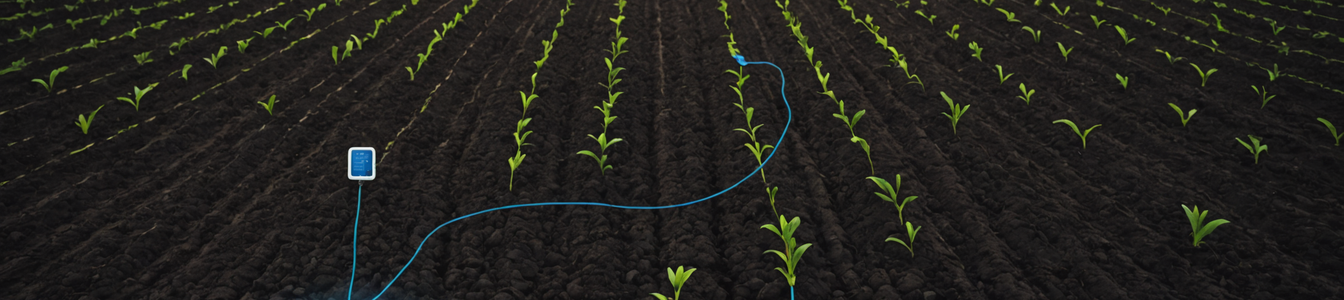
The agricultural sector is undergoing a profound digital revolution, with Internet of Things (IoT) technologies promising unprecedented efficiency through precision farming. However, this transformation is creating a sprawling new attack surface that cybersecurity professionals are only beginning to map and secure. Recent technological deployments in India's agricultural infrastructure highlight both the potential and the peril of this convergence between food production and connected technology.
Precision Farming's Double-Edged Sword
Companies like Varsapradaya are at the forefront of bringing IoT solutions to traditional agriculture, recently unveiling specialized precision farming devices for India's coffee sector. These systems typically incorporate networks of sensors monitoring soil moisture, nutrient levels, temperature, and humidity, connected to automated irrigation and fertilization systems. While this data-driven approach optimizes resource use and crop yields, it creates multiple entry points for cyber threats. Many agricultural IoT devices are deployed with default credentials, unencrypted communications, and minimal update mechanisms, making them vulnerable to compromise.
The security implications extend beyond individual farms. Compromised sensor data could lead to incorrect irrigation or fertilization decisions, damaging crops or reducing yields. More concerning is the potential for attackers to manipulate entire supply chains by altering data that informs harvest timing, quality assessments, or logistics planning. For high-value crops like coffee, such interference could have significant economic consequences and affect global markets.
Energy Infrastructure as an Agricultural Vulnerability
Parallel developments in agricultural energy infrastructure, exemplified by GHV Infra Projects securing substantial contracts for 28.83 MWp rooftop solar plants, introduce additional cybersecurity dimensions. Modern agricultural operations increasingly depend on distributed energy resources, including solar installations that power IoT networks, processing facilities, and cold storage units. These energy systems are themselves becoming smart and connected, often managed through SCADA (Supervisory Control and Data Acquisition) systems and industrial control systems (ICS) that were not designed with contemporary cyber threats in mind.
A cyberattack targeting agricultural solar infrastructure could cripple the power supply to critical farming operations, disrupting IoT sensor networks, automated equipment, and climate-controlled storage facilities. The interconnected nature of these systems means that an attack on energy infrastructure could cascade through the entire agricultural value chain, from field to distribution.
Unique Cybersecurity Challenges in Agricultural IoT
The agricultural environment presents distinct challenges for cybersecurity implementation. Many IoT devices are deployed in remote locations with limited physical security and connectivity constraints that complicate regular security updates. The convergence of operational technology (OT)—the physical systems controlling irrigation, machinery, and climate—with traditional IT networks creates hybrid environments that many security teams are unprepared to defend.
Furthermore, agricultural supply chains involve numerous stakeholders with varying levels of cybersecurity maturity, from small family farms to large agribusiness corporations and logistics providers. This heterogeneity creates security gaps that attackers can exploit, particularly through supply chain attacks targeting widely used agricultural technology platforms or components.
Emerging Threat Vectors and Defense Strategies
Security researchers have identified several emerging threat vectors specific to agricultural IoT:
- Data Integrity Attacks: Manipulation of sensor data to cause physical damage to crops or inefficient resource allocation.
- Ransomware Targeting Critical Timelines: Attacks timed to planting or harvest seasons when operational disruption causes maximum financial damage.
- Supply Chain Disruption: Attacks on logistics and distribution systems that depend on IoT data for routing and scheduling.
- Intellectual Property Theft: Extraction of proprietary agricultural data, including crop genetics, soil analysis, and yield optimization algorithms.
Defending these systems requires a multi-layered approach that addresses both technical and operational challenges. Security measures must include network segmentation to isolate critical control systems, implementation of strong authentication and encryption for all IoT communications, regular security assessments of agricultural technology deployments, and incident response plans tailored to the agricultural calendar and its critical periods.
The Path Forward: Building Cyber-Resilient Agriculture
As the agricultural sector continues its digital transformation, cybersecurity must become an integral component of agricultural technology design and deployment. This requires collaboration between cybersecurity professionals, agricultural engineers, equipment manufacturers, and policymakers to establish security standards for agricultural IoT.
Key priorities include developing lightweight security protocols suitable for resource-constrained agricultural devices, creating certification programs for secure agricultural technology, and establishing information-sharing mechanisms specific to agricultural cybersecurity threats. Additionally, training programs must be developed to help agricultural workers and managers recognize and respond to cyber threats in their increasingly digital operations.
The stakes extend beyond individual farms or companies. As food production systems become more interconnected and data-dependent, their security becomes a matter of food security at regional and potentially global scales. The cybersecurity community's engagement with the agricultural sector is no longer optional but essential to ensuring the resilience of our food supply chains in an increasingly digital and threatened world.
Comentarios 0
Comentando como:
¡Únete a la conversación!
Sé el primero en compartir tu opinión sobre este artículo.
¡Inicia la conversación!
Sé el primero en comentar este artículo.