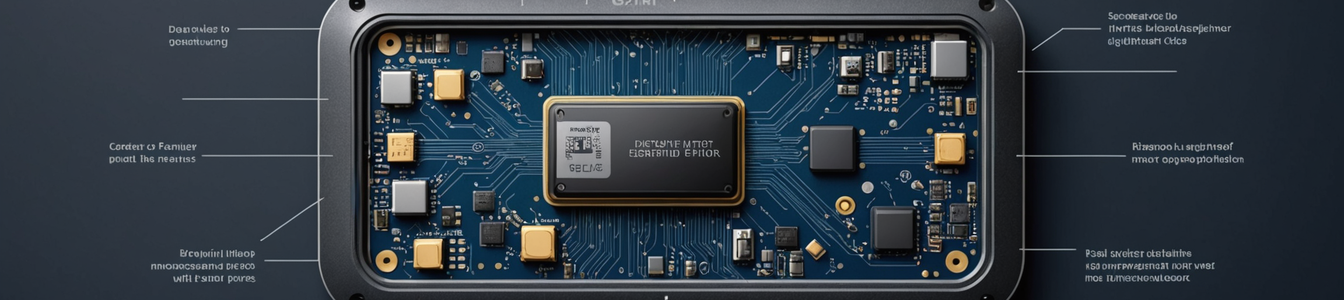
The cybersecurity narrative surrounding the Internet of Things (IoT) has long been dominated by software flaws, insecure APIs, and weak network protocols. However, a fundamental shift is occurring beneath the surface, driven by innovations in the very components that give IoT devices their ability to sense, power, and operate in the real world. The convergence of novel sensor technologies and advanced battery systems is quietly building a new hardware foundation for IoT, one that expands its reach into extreme environments and critical functions—and in doing so, redefines the security landscape in profound ways.
The Sensor Revolution: From Railways to Molecular Sniffing
Sensors are the eyes, ears, and noses of the IoT. Recent breakthroughs are making these organs vastly more capable and specialized, thereby embedding them deeper into safety-critical systems. One significant development is the discovery of new magnetic sensor materials through high-throughput experimental methods. This approach allows researchers to rapidly screen thousands of material combinations, identifying candidates with superior sensitivity, stability, and potentially lower cost. For cybersecurity, the integrity of these materials is paramount. A sensor that monitors the magnetic signature of a high-speed train axle (a key application highlighted by Wabtec's acquisition of Frauscher Sensor Technology) must be inherently trustworthy. Any undetectable flaw or malicious tampering at the material level could lead to catastrophic failure or spoofed safety signals, bypassing all software security layers.
Wabtec's strategic move to finalize its acquisition of Frauscher Sensor Technology Group underscores the growing value of specialized sensing in industrial and transportation IoT. Frauscher's expertise in wheel sensors, axle counters, and acoustic rail detection is integral to railway safety and efficiency. Securing such systems now requires a hardware-aware approach, where the sensor's data lineage—from the physical phenomenon to the digital signal—must be verifiable and tamper-evident. The supply chain for these advanced materials and components becomes a critical attack vector, where nation-states or sophisticated actors could implant weaknesses long before the device reaches the field.
Simultaneously, bio-inspired sensor designs are emerging for environmental and security monitoring. Researchers have developed a 'sugar-coated' sensor capable of distinguishing between look-alike molecules in the air. By using cyclodextrins (sugar-based compounds) as selective binding sites, this sensor can identify specific volatile organic compounds with high precision. This technology has clear applications in industrial leak detection, air quality monitoring, and even security screening for explosives or chemical agents. From a cybersecurity perspective, the algorithm that interprets the sensor's raw data becomes a high-value target. Poisoning the training data for its AI model or manipulating its calibration could cause it to ignore a toxic leak or trigger a false alarm, leading to physical harm or operational disruption.
The Power Enabler: Conquering the Cold with Advanced Batteries
IoT's expansion is equally constrained by power. A sensor is useless if it cannot operate reliably. This is where the rise of low-temperature lithium technology becomes a game-changer, particularly for Industrial IoT (IIoT). Traditional lithium-ion batteries suffer severe capacity loss and failure in sub-zero temperatures, limiting IoT deployments in cold climates, frozen supply chains, and outdoor industrial settings.
New low-temperature lithium formulations are solving this problem, enabling year-round operation for remote sensors in arctic conditions, monitoring systems for frozen food logistics, and infrastructure sensors in winter climates. For security teams, this advancement has a dual impact. First, it extends the physical attack surface. Previously inaccessible or seasonal locations now host persistent, connected devices that require physical security considerations alongside digital ones. Second, the battery management system (BMS) itself becomes a critical security component. A compromised BMS could be instructed to overcharge, deep-discharge, or thermally abuse the battery, leading to permanent failure (a denial-of-service attack) or even a fire (a physical kinetic attack). The security of the battery's firmware and its communication with the host device is no longer just about device longevity—it's a safety issue.
Convergence and the New Security Imperative
The trends in sensors and batteries are not isolated. They are converging to enable comprehensive monitoring ecosystems, as seen in China's push for 'Ecological Domain' monitoring and automotive hardware expansion. The integration of AI, advanced sensing, and reliable power is creating 'intelligent entities' that autonomously monitor forests, rivers, urban infrastructure, and vehicle health.
This functional integration creates a layered security challenge:
- Hardware Integrity: Ensuring the sensors and power systems are manufactured, shipped, and installed without hidden backdoors or integrity flaws.
- Data Provenance: Verifying that the data generated by a novel magnetic or chemical sensor is authentic and has not been spoofed at the physical or analog signal level.
- Supply Chain Sovereignty: Navigating the geopolitical tensions inherent in sourcing advanced materials and components, where strategic dependencies can become national security risks.
- Lifecycle Security: Managing the security of these devices over decades-long lifespans in harsh environments, where physical maintenance and software updates are challenging.
Conclusion: Securing the Hidden Backbone
The future of IoT security is being written not just in code, but in material science labs and battery chemistry facilities. As sensors become more sophisticated and power systems more resilient, the IoT will penetrate deeper into the physical fabric of society. Cybersecurity professionals must expand their expertise to encompass this hidden hardware backbone. This means advocating for hardware root of trust in sensors, demanding secure boot and firmware integrity for battery systems, and understanding the supply chain risks of exotic materials. The next major IoT breach may not start with a phishing email or a buffer overflow, but with a manipulated sensor material or a hijacked battery cell, proving that in the world of IoT, the deepest vulnerabilities are often the ones you cannot see—until they fail.
Comentarios 0
Comentando como:
¡Únete a la conversación!
Sé el primero en compartir tu opinión sobre este artículo.
¡Inicia la conversación!
Sé el primero en comentar este artículo.