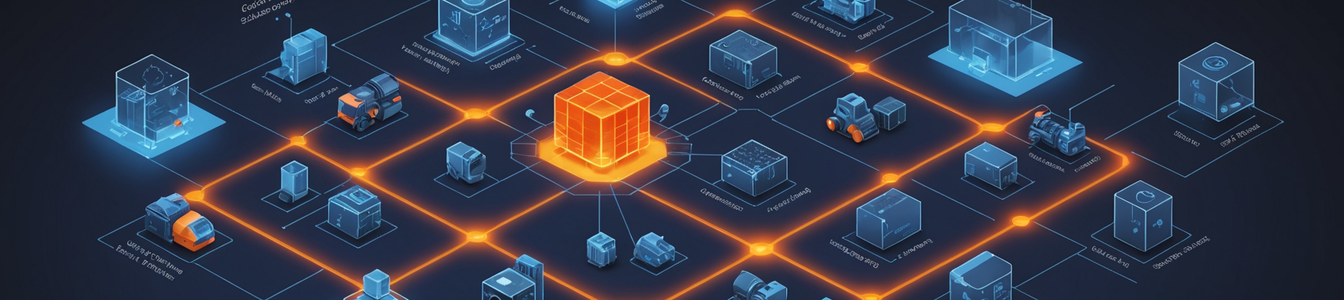
The Internet of Things (IoT) is undergoing a silent but profound hardware revolution. Beyond the familiar cameras and microphones, a new generation of sophisticated, miniaturized, and increasingly affordable sensors is embedding itself into everything from consumer vehicles and smart homes to industrial control systems. This sensor revolution, driven by innovations in thermal imaging, LiDAR, hyperspectral detection, and nanoscale sensing, is not merely an incremental upgrade. It represents a fundamental expansion of the IoT's perceptual capabilities—and, consequently, a dramatic widening of its attack surface that the cybersecurity community is only beginning to comprehend.
From Niche to Mainstream: The Proliferation of Specialized Eyes
The core of this shift is the commoditization of sensing technologies once reserved for military, scientific, or high-end industrial applications. Meridian Innovation's recent unveiling of the 'Cheetah,' a 50x50 pixel Long-Wave Infrared (LWIR) thermal imaging sensor, is a prime example. By offering high performance at a cost-optimized price point, such sensors will inevitably migrate from security perimeters and industrial diagnostics into consumer devices, smart home hubs, and even personal wearables. Suddenly, the ability to see heat signatures—to detect human presence through walls, identify operational equipment, or monitor physiological stress—becomes a widely available data stream.
Simultaneously, LiDAR technology is becoming deeply integrated into our physical environment. Aeva Technologies is showcasing a passenger vehicle with windshield-integrated 4D LiDAR at CES 2026. This move beyond rooftop 'spinning buckets' to seamless integration creates a persistent, high-resolution 3D mapping capability in everyday objects. When combined with other advancements, like Toshiba's new lens-reduction type CCD linear image sensor designed for ultra-high-speed data readouts in inspection equipment, it's clear that the volume, velocity, and variety of environmental data being captured are exploding.
Beyond Vision: The Rise of Inferential and Chemical Sensing
The revolution extends beyond imaging. Researchers have developed a nanowire-based sensor capable of rapid identification of toxic indoor molds, representing a leap in environmental and health monitoring. In parallel, collaborations like that between Singular Photonics and Renishaw are advancing integrated photonics for spectroscopy, enabling compact devices that can analyze the chemical composition of materials in real-time.
These sensors move from 'seeing' to 'inferring.' They don't just capture a picture; they detect specific chemical agents, biological contaminants, or material properties. This creates data streams of immense sensitivity—indicating the presence of illicit substances, chemical leaks, or specific manufacturing processes—all now potentially accessible via networked IoT devices.
The Expanded Attack Surface: New Vectors for a New Era
For cybersecurity professionals, this proliferation creates a multi-faceted threat landscape that traditional device-hardening strategies are ill-equipped to handle:
- The Privacy Apocalypse Goes Non-Visual: The debate has moved beyond facial recognition. A hijacked thermal sensor in a smart speaker could monitor occupancy patterns in a home, infer sleep cycles, or even detect specific activities based on heat signatures. 4D LiDAR data from a vehicle or building sensor could be used to build precise behavioral models of individuals, tracking gait and movement with alarming accuracy, regardless of lighting conditions or obstructions.
- Sensor Spoofing and Adversarial Attacks on the Physical World: These sensors make critical decisions. A spoofed thermal signature could trick a security system into seeing a non-existent intruder or, more dangerously, hiding a real one. Adversarial attacks against LiDAR point clouds are already a research topic in autonomous vehicles; as LiDAR proliferates in infrastructure, the risk of manipulating environmental perception for fraud, sabotage, or causing physical accidents grows exponentially. Could a manipulated chemical sensor signal trigger a false emergency shutdown in a factory or a hazardous leak alert in a city?
- The Data Integrity Crisis: The value of the data from these sensors is extraordinarily high. An attacker who compromises a network of environmental mold sensors could falsify reports to devalue property or extort building owners. Tampering with spectroscopic data in a supply chain IoT system could mask material defects or the presence of counterfeit goods.
- Supply Chain and Firmware Blind Spots: These complex sensors are often 'black boxes' sourced from specialized vendors. Their embedded firmware and data processing pipelines represent a deep and often unaudited layer of the software stack. A vulnerability in the image signal processor (ISP) of a thermal camera or the point-cloud generation algorithm of a LiDAR unit could provide a stealthy, persistent backdoor into the entire device network.
Toward a New Security Paradigm
Addressing this new reality requires a paradigm shift. Security can no longer be an afterthought bolted onto a sensor module. The principles of 'Security by Design' must be applied at the sensor silicon and firmware level. This includes:
- Secure Boot and Firmware Signing: Ensuring the integrity of the sensor's own operating code from the moment of power-on.
- Encrypted Data Paths: Implementing end-to-end encryption for sensor data from the pixel to the application, preventing eavesdropping or injection.
- Sensor Data Provenance and Integrity Checks: Developing methods to cryptographically verify that sensor data is authentic and has not been altered in transit or at rest.
- Robustness Testing Against Adversarial Inputs: Actively testing sensor systems against spoofed inputs—fake thermal patterns, deceptive LiDAR signals, or chemical sensor interference—as part of the security validation process.
- Context-Aware Privacy Frameworks: Developing new data governance models that recognize the uniquely invasive nature of these data streams, potentially requiring explicit user consent for activation or strict data anonymization and localization policies.
The sensor revolution is unlocking incredible potential for automation, safety, and efficiency. However, it is also constructing a panopticon of unprecedented granularity, with its components scattered across our daily lives. For the cybersecurity industry, the race is on to build the walls, guards, and ethical frameworks for this new world before its vulnerabilities are exploited at scale. The attack surface is no longer just digital; it is now a layer superimposed on our physical reality, and securing it will be one of the defining challenges of the next decade.
Comentarios 0
Comentando como:
¡Únete a la conversación!
Sé el primero en compartir tu opinión sobre este artículo.
¡Inicia la conversación!
Sé el primero en comentar este artículo.