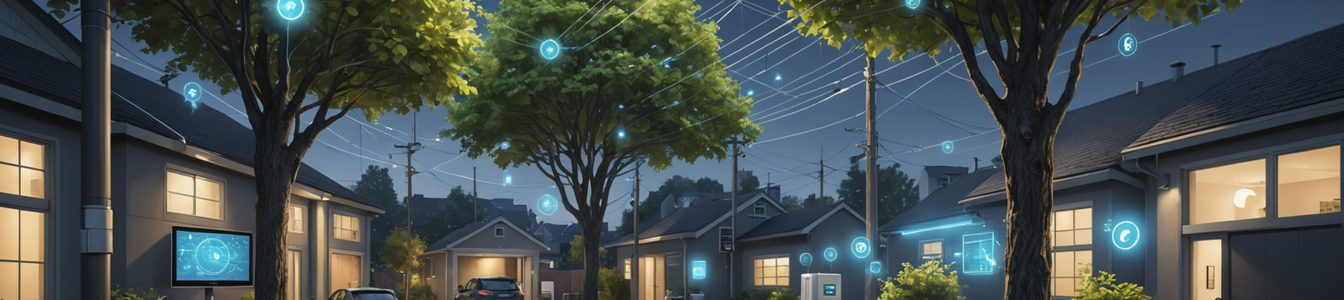
The definition of critical infrastructure is quietly expanding beyond power grids and water treatment plants to include the networked sensors monitoring urban trees and the automated systems securing private garages. This new frontier of IoT deployment—spanning both municipal environmental management and personal property automation—creates a complex security landscape where traditional cybersecurity paradigms struggle to keep pace with the physical implications of digital compromise.
The Urban Forest as a Networked Ecosystem
Modern cities are increasingly deploying IoT sensor networks to monitor and protect their urban forests—the "green lungs" that provide essential environmental services. These systems typically consist of distributed sensors measuring soil moisture, nutrient levels, temperature, and air quality, transmitting data via LPWAN protocols like LoRaWAN or cellular networks to centralized management platforms. The operational benefits are substantial: predictive maintenance, optimized irrigation, early disease detection, and data-driven urban planning.
From a cybersecurity perspective, these environmental monitoring networks represent a novel attack surface. While they may not seem as immediately critical as SCADA systems controlling dams, compromised urban forestry sensors could enable several attack vectors: data manipulation to trigger inappropriate watering (wasting resources or damaging trees), false environmental readings affecting public health advisories, or even using the sensor network as an entry point to connected municipal systems. The distributed nature of these deployments—often in publicly accessible locations—makes physical security challenging, while the typical use of cost-optimized hardware may mean inadequate security features.
The Smart Garage: Convenience with Security Implications
Parallel to municipal deployments, consumer IoT is transforming private spaces like garages into automated security and convenience hubs. Modern smart garage systems integrate multiple functions: automated door control with smartphone integration, motion-activated lighting, environmental monitoring for temperature and humidity, and integration with broader home automation ecosystems. These systems often connect via Wi-Fi or Bluetooth to cloud services, creating a bridge between physical property security and digital networks.
The cybersecurity implications here are more immediately personal but no less systemic. A compromised smart garage system could provide attackers with physical access to a home, disable security lighting, or serve as a pivot point to attack other connected home systems. Many consumer IoT devices suffer from well-documented vulnerabilities—default credentials, unencrypted communications, inadequate update mechanisms—that become particularly dangerous when they control physical access points. The convergence of convenience and security in these systems creates tension between usability and protection, often resolved in favor of the former.
Converging Threats and Expanded Attack Surfaces
What makes these disparate applications significant from a security perspective is their convergence in creating what might be termed "ambient critical infrastructure"—systems whose compromise could have physical consequences but that don't fit traditional critical infrastructure models. Both urban forestry sensors and smart garage systems share several concerning characteristics:
- Pervasive Deployment: They're distributed across numerous locations, making consistent security management difficult
- Mixed Ownership Models: They span municipal and private ownership, complicating responsibility and incident response
- Physical-Digital Integration: They bridge the digital and physical worlds in ways that create new risk profiles
- Often-Inadequate Security: They frequently prioritize cost, convenience, or functionality over security
Security Framework Recommendations
Addressing these challenges requires a new security mindset that recognizes the criticality of these emerging IoT applications:
For Municipal Environmental IoT:
- Implement network segmentation to isolate sensor networks from core municipal systems
- Deploy cryptographic authentication for all sensor-to-gateway communications
- Establish continuous monitoring for anomalous data patterns that might indicate compromise
- Develop incident response plans specific to environmental sensor manipulation
For Consumer Property Automation:
- Mandate strong authentication mechanisms, eliminating default credentials
- Ensure end-to-end encryption for all communications, including local network traffic
- Implement secure, reliable over-the-air update mechanisms
- Educate consumers about the security—not just convenience—implications of their IoT purchases
The Regulatory Landscape Gap
Current regulatory frameworks for critical infrastructure largely overlook these emerging IoT applications. While industrial control systems have well-established security standards (like IEC 62443), no equivalent exists for urban environmental sensors or residential automation systems with security functions. This regulatory gap creates inconsistent security postures and unclear accountability when incidents occur.
Future Implications
As cities become smarter and homes more automated, the boundary between environmental management and security systems will continue to blur. We're already seeing early integration where smart city data informs residential systems and vice versa. This interoperability—while beneficial—creates cascading failure risks that security architectures must anticipate.
The professional cybersecurity community must expand its focus beyond traditional IT systems and industrial controls to include these pervasive, often-overlooked IoT deployments. Security assessments should consider not just data theft but manipulation, not just digital access but physical consequences, and not just immediate impacts but long-term systemic risks.
Conclusion
The silent sentinels monitoring our urban forests and securing our private garages represent both technological progress and security evolution. They challenge us to rethink what deserves protection, how we secure distributed systems with physical implications, and who bears responsibility for emerging infrastructure categories. As these technologies become increasingly embedded in our daily environments, the cybersecurity community has an urgent responsibility to develop appropriate frameworks, standards, and best practices before incidents force reactive responses. The security of our future cities depends not just on protecting traditional infrastructure but on securing the ambient intelligence increasingly surrounding us.
Comentarios 0
Comentando como:
¡Únete a la conversación!
Sé el primero en compartir tu opinión sobre este artículo.
¡Inicia la conversación!
Sé el primero en comentar este artículo.