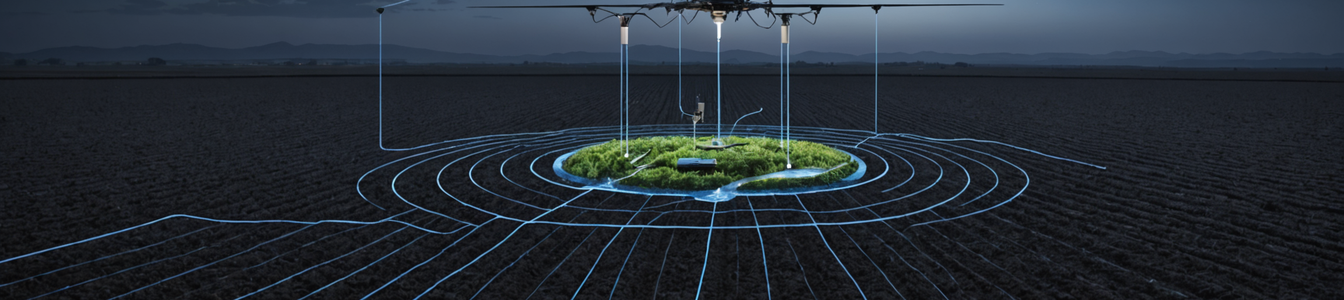
The Internet of Things revolution has moved beyond smart homes and connected cars into previously unimagined territories: agricultural fields, global supply chains, and even Earth orbit. This sensor sprawl into unlikely places is creating a massive, often unmanaged attack surface that cybersecurity professionals are only beginning to comprehend. From farm to space, specialized IoT devices are being integrated into critical systems with minimal security considerations, presenting unprecedented risks to industrial operations, environmental monitoring, and national infrastructure.
Agricultural IoT: The New Frontier of Supply Chain Vulnerabilities
Recent developments in India and China highlight how IoT sensors are transforming agriculture while introducing new security challenges. In Bihar, India, researchers have patented a sensor-based system designed to protect Geographical Indication (GI) products—specialty agricultural goods tied to specific regions. These systems monitor environmental conditions, soil composition, and growth parameters to verify product authenticity throughout the supply chain. While this addresses economic fraud, it creates a distributed network of sensors collecting sensitive agricultural data with unclear security postures.
Similarly, China's rural revitalization initiatives are driving widespread adoption of IoT sensors in specialty agriculture. These systems monitor everything from soil moisture to crop health, transmitting data to centralized platforms for analysis. The cybersecurity implications are substantial: these agricultural sensors often use legacy communication protocols, lack encryption, and connect to broader farm management systems that may interface with critical infrastructure. An attacker compromising these sensors could manipulate agricultural data, disrupt food supply chains, or use them as entry points to broader industrial control systems.
Space-Based Sensors: When Environmental Monitoring Meets Critical Infrastructure
NASA's Earth Surface Mineral Dust Source Investigation (EMIT) sensor aboard the International Space Station exemplifies how sensor technology is expanding into space-based applications with dual-use capabilities. Originally designed to map mineral dust, EMIT has demonstrated unexpected utility in detecting ocean plastic pollution. This repurposing of sensor data highlights both the versatility of modern sensing technology and the potential security implications of multi-purpose sensor networks.
Space-based sensors like EMIT connect to ground stations, research facilities, and environmental monitoring networks. Their data feeds into climate models, policy decisions, and commercial applications. The security of these space-to-ground communication links, data processing pipelines, and integration points with terrestrial systems represents a largely unaddressed vulnerability. A compromised environmental sensor in space could feed manipulated data into climate models or serve as a relay point for attacks against connected ground infrastructure.
Advanced Sensory Systems: Converging Capabilities, Converging Risks
The development of sophisticated multi-sensory robots represents another dimension of sensor sprawl. Researchers are creating systems that provide robots with 180-degree vision and artificial olfactory capabilities, enabling unprecedented environmental awareness and interaction. These systems combine multiple sensor modalities—visual, chemical, thermal—into integrated platforms that will increasingly be deployed in industrial, agricultural, and environmental monitoring applications.
From a cybersecurity perspective, these advanced sensory systems represent convergence points where multiple data streams and control systems intersect. Their complex sensor fusion algorithms, communication interfaces, and integration with robotic control systems create multiple potential attack vectors. An attacker who compromises a robot's olfactory sensor, for example, could feed false chemical data that causes the system to misinterpret environmental hazards or product quality.
The Expanding Attack Surface: Technical and Operational Challenges
The security challenges presented by this sensor sprawl are multifaceted. Many agricultural and environmental sensors operate on battery power with limited computational resources, making traditional security controls impractical. They often use proprietary or legacy communication protocols that lack built-in security features. Their deployment in remote or harsh environments makes physical security difficult, while their integration into supply chain and industrial systems creates potential bridgeheads into critical infrastructure.
Supply chain vulnerabilities are particularly concerning. Sensors deployed across global agricultural networks or space-based platforms involve complex supply chains with multiple vendors, integrators, and service providers. Each link in this chain represents a potential compromise point, whether through malicious hardware implants, vulnerable software components, or compromised maintenance procedures.
Mitigation Strategies for an Expanding Frontier
Addressing the security implications of sensor sprawl requires a multi-layered approach:
- Zero-Trust Architectures for Sensor Networks: Implement strict access controls, continuous authentication, and micro-segmentation for sensor networks, regardless of their perceived isolation.
- Enhanced Supply Chain Security: Develop rigorous vetting processes for sensor manufacturers, firmware providers, and integration partners, with particular attention to components used in critical applications.
- Sector-Specific Security Frameworks: Create security standards tailored to agricultural IoT, environmental monitoring systems, and space-based sensor networks that address their unique constraints and risk profiles.
- Secure-by-Design Sensor Development: Encourage manufacturers to build security into sensors from the initial design phase, including hardware-based security features, secure boot processes, and encrypted communications.
- Continuous Monitoring and Anomaly Detection: Implement systems to monitor sensor behavior for anomalies that might indicate compromise, manipulation, or malfunction.
As sensors continue their march into farms, factories, and orbit, the cybersecurity community must expand its focus beyond traditional IT systems. The unmanaged IoT attack surface is growing in directions we're only beginning to map, and securing these distributed, specialized systems will require new approaches, collaborations across sectors, and a fundamental rethinking of what constitutes critical infrastructure in an increasingly sensor-driven world.
Comentarios 0
Comentando como:
¡Únete a la conversación!
Sé el primero en compartir tu opinión sobre este artículo.
¡Inicia la conversación!
Sé el primero en comentar este artículo.