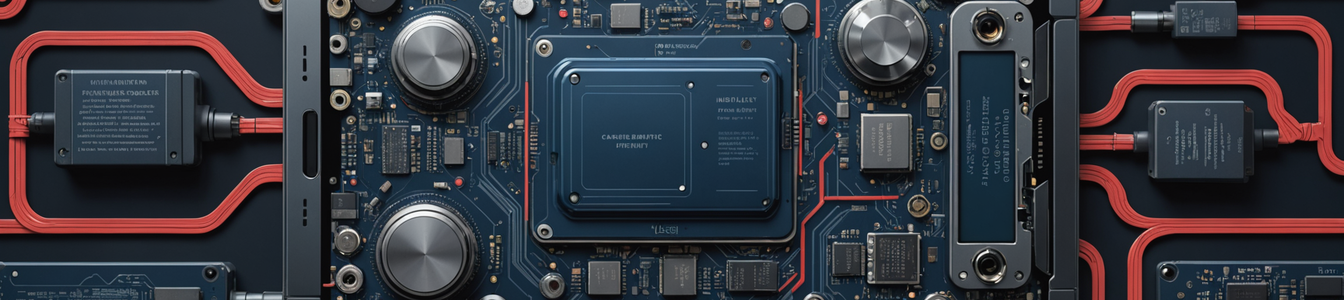
The smartphone industry's race for innovation is entering a dangerous new phase, one where cutting-edge hardware features are outpacing the security models designed to protect them. As manufacturers integrate increasingly complex and novel physical components—from mechanical camera controls to enormous batteries and intricate folding mechanisms—they are unwittingly constructing a hardware honeypot for sophisticated attackers. This shift moves the threat landscape beyond software exploits and into the tangible realm of supply chain compromise, physical tampering, and hardware-based backdoors that are invisible to conventional security scans.
The New Physical Attack Surface
The recently unveiled Xiaomi 17 Ultra Leica Edition exemplifies this trend. Its headline feature is a manual, mechanical zoom ring around the camera lens, a tactile control borrowed from professional photography. While enhancing user experience, this ring represents a new ingress point. It is a physical interface connected to internal circuitry. A malicious actor with brief access to the device could potentially tamper with this mechanism to install a micro-component that intercepts signals between the ring and the image signal processor (ISP). Such an implant could, theoretically, corrupt image data, inject malicious code into the camera subsystem, or act as a listening device if the firmware controlling the haptic feedback is compromised.
Similarly, the industry's push for extreme battery life, highlighted by rumors of a OnePlus 'Turbo' model with a 9,000mAh cell and the Xiaomi 17 Ultra's confirmed 6,800mAh battery, creates a massive supply chain risk. These batteries are not just power sources; they are complex components with their own management circuitry (BMS - Battery Management System). A compromised BMS, introduced at any point in a sprawling global supply chain, could be programmed to fail catastrophically (a safety threat) or, more subtly, to leak power usage data—revealing user activity patterns—or even to create a persistent power bridge that survives a factory reset.
Form Factor Fragility and Data Extraction
The vulnerability extends to structural innovation. Durability tests of Samsung's ambitious Galaxy Z TriFold have shown it to be particularly fragile at its complex hinge points. For cybersecurity professionals, physical fragility is a direct security concern. A device that fails easily under stress is more likely to fall into the hands of repair shops or, worse, be discarded while still containing retrievable data. The intricate, non-standard internal layout of foldables makes secure data sanitization and component-level destruction more difficult, increasing the risk of data recovery from damaged units. This creates a lucrative secondary market for 'broken' devices that still hold intact storage chips.
The Supply Chain Black Box
The core issue underpinning all these examples is the opacity and complexity of modern hardware supply chains. The mechanical zoom ring, the oversized battery, the flexible display, and the multi-joint hinge are each sourced from specialized suppliers, who in turn rely on sub-suppliers. At every tier, the opportunity for introducing a malicious hardware modification—a tiny chip on a flex cable, a reprogrammed microcontroller in a battery, a compromised sensor in a camera module—exists. These are not theoretical threats. Nation-state actors and sophisticated criminal groups have long exploited hardware supply chains. The difference now is that consumer devices are incorporating bespoke, low-volume hardware features that may lack the rigorous, security-focused auditing common in more standardized components.
Implications for Enterprise and Personal Security
This evolution demands a paradigm shift in mobile security. Traditional models focused on app sandboxing, network firewalls, and malware detection are blind to these hardware-level threats. A device with a tampered battery management system or a compromised camera sensor may pass all software integrity checks with flying colors while being fundamentally untrustworthy.
For enterprise security teams, this means:
- Expanding Due Diligence: Vendor security assessments must now include deep inquiries into hardware sourcing, component verification, and factory integrity, not just software update policies.
- Physical Security Parity: Treating high-risk employee devices with the same physical security protocols as laptops, including tamper-evident seals and strict control over third-party repairs.
- Incident Response Adaptation: Forensic procedures must account for the possibility of hardware-based persistence. A 'clean' OS reflash may no longer be sufficient to guarantee a secure device.
For manufacturers, the imperative is to build security-by-design into hardware innovation. This includes implementing hardware root-of-trust that can verify the integrity of peripheral components, creating secure communication channels between subsystems (like the zoom ring and the ISP), and designing for physical tamper-resistance and evident destruction of critical data chips upon structural failure.
The era of the smartphone as a purely software-defined device is over. The next generation of mobile security will be fought not just in code, but in the very silicon, solder, and mechanical joints that make up our most personal computers. Ignoring the hardware attack surface is a luxury the industry can no longer afford.
Comentarios 0
Comentando como:
¡Únete a la conversación!
Sé el primero en compartir tu opinión sobre este artículo.
¡Inicia la conversación!
Sé el primero en comentar este artículo.