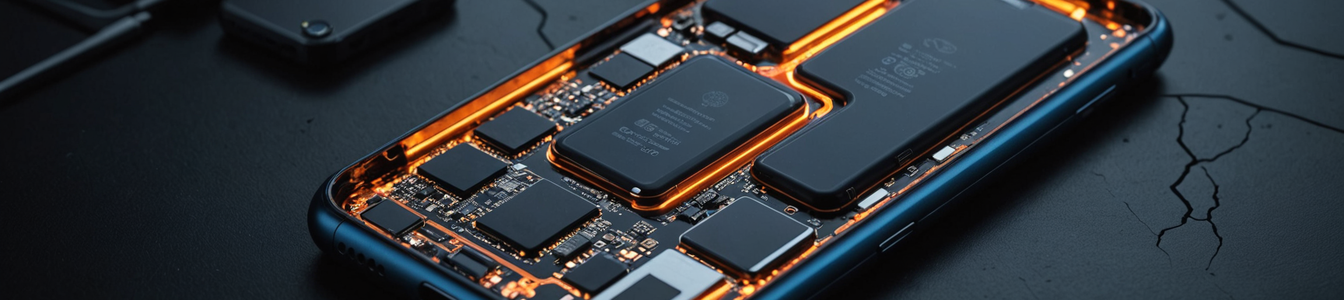
The cybersecurity community has long focused on defending against malware, network intrusions, and data breaches. However, a more visceral threat is emerging from an unexpected vector: the physical hardware of the very devices we carry in our pockets. Recent incidents of smartphones catching fire or failing catastrophically signal a critical expansion of the security perimeter—one that now must encompass the integrity of the device itself. This shift represents a fundamental challenge, moving security concerns from the purely digital realm into the physical safety of end-users.
The Incident That Sparked Concern
A disturbing video circulating on social media, reportedly from India, shows the aftermath of a Motorola smartphone—believed to be from the G-series—catastrophically failing in a man's pocket. This is not an isolated software glitch but a hardware-level failure with dangerous physical consequences. Such incidents transcend traditional cybersecurity metrics, presenting immediate risks of burns, property damage, and personal injury. They serve as a stark reminder that a compromised supply chain or manufacturing defect can be as damaging as any sophisticated cyberattack.
Industry Trends Amplifying the Risk
Analysis of the smartphone market in 2025 reveals a troubling dichotomy. While specifications on paper continue to improve with faster processors and higher-resolution cameras, the real-world user experience and, crucially, device reliability have not kept pace. The relentless drive to reduce costs and shorten time-to-market, particularly in the competitive budget and mid-range Android segments, is applying immense pressure on manufacturing and component sourcing. This pressure cooker environment creates fertile ground for compromises in quality control and the infiltration of substandard components into the supply chain.
Experts cited in industry reports project that this trajectory is unsustainable. By 2026, the very market for low-cost Android phones could be disrupted not by software or a lack of features, but by a fundamental crisis of confidence in hardware safety and longevity. The race to the bottom on price is potentially creating a ticking time bomb of latent hardware faults.
Beyond Batteries: A Spectrum of Hardware Anomalies
While lithium-ion battery failures—often due to separator defects, contamination, or charging circuit issues—are the most dramatic and dangerous, they are not the only hardware concerns. Reports have also surfaced regarding other anomalies, such as certain iPhone 17 Pro units emitting unusual buzzing or whining noises during charging. While less immediately hazardous than a fire, such symptoms can indicate underlying issues with voltage regulation, coil whine in charging circuits, or other component stress. These auditory warnings are the hardware equivalent of a suspicious log entry—a sign that something is not operating within its intended parameters.
For cybersecurity and IT professionals, these hardware failures represent a new class of asset risk. Managed device fleets in enterprises could be susceptible to these physical defects, posing duty-of-care challenges, potential liability issues, and operational disruption if devices fail en masse.
The Cybersecurity Imperative: Expanding the Threat Model
This evolution demands that cybersecurity frameworks expand. The traditional CIA triad—Confidentiality, Integrity, Availability—must now explicitly consider Physical Safety as a core security property for endpoint devices. Security teams must begin to ask new questions: How do we validate the hardware integrity of our devices? What is our response plan for a physical device failure that poses a safety risk? How do we audit the supply chain for hardware components with the same rigor we apply to software dependencies?
Mitigation and Response Strategies
Organizations and security professionals can take several steps to address this evolving threat landscape:
- Supply Chain Diligence: Security questionnaires for device vendors must now include detailed inquiries about hardware sourcing, quality control standards (beyond basic certifications), and historical data on physical failure rates. Understanding a vendor's second- and third-tier component suppliers becomes crucial.
- Enhanced Monitoring: Endpoint Detection and Response (EDR) and Mobile Device Management (MDM) solutions should be configured to monitor for physical symptoms reported by users. Anomalies like excessive heat (via temperature sensors), unexpected battery drain patterns, or user reports of strange noises or device swelling should be treated as potential security/safety incidents.
- User Awareness Training: Cybersecurity awareness programs should incorporate guidance on recognizing signs of hardware distress: a device becoming unusually hot, bulging or deformed casing, hissing or popping sounds, and erratic charging behavior. Users must be empowered to report these issues immediately and know how to safely isolate a suspect device (e.g., powering it down and placing it in a fire-resistant container if swelling is detected).
- Incident Response Planning: Incident Response (IR) playbooks need modules for hardware failure events. This includes procedures for safe device isolation, evidence preservation for potential legal or insurance claims, communication protocols with the device manufacturer, and steps for fleet-wide risk assessment if a model is found to be defective.
Conclusion: A New Frontier in Device Trust
The incidents of smartphones failing catastrophically mark a pivotal moment. They underscore that trust in a digital device is not solely about the security of its data but fundamentally about the reliability and safety of its physical construction. For the cybersecurity community, this is a call to broaden its expertise. Collaborating with hardware engineers, supply chain specialists, and product safety experts will become essential. In the coming years, the most secure device won't just be impervious to hackers; it will be one whose hardware integrity is verifiable and whose failure modes are safe. Protecting users now means safeguarding them from both digital intruders and the physical failure of the technology they depend on every day.
Comentarios 0
Comentando como:
¡Únete a la conversación!
Sé el primero en compartir tu opinión sobre este artículo.
¡Inicia la conversación!
Sé el primero en comentar este artículo.