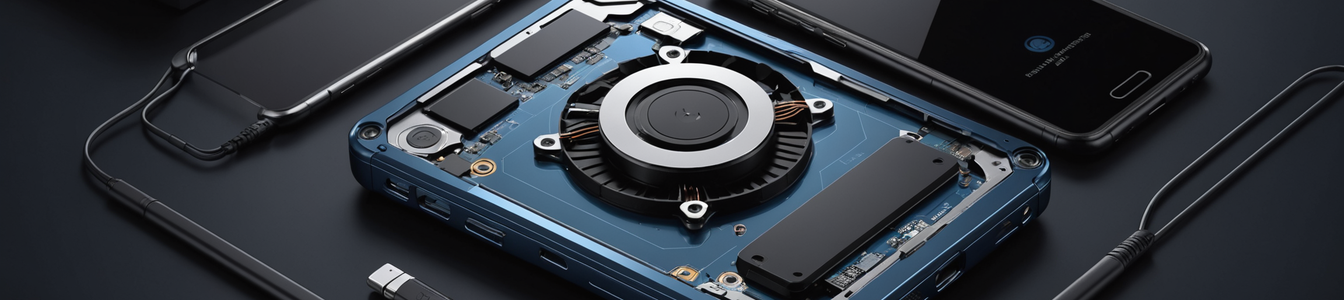
The smartphone arms race has entered a new, physically intensive phase. Manufacturers, locked in competition over raw performance and battery life, are integrating increasingly complex hardware subsystems. Two recent developments exemplify this trend: Xiaomi's exploration of smartphones with integrated active cooling fans to combat processor throttling, and Realme's certification of a device boasting a colossal 10,000mAh battery. While consumers may celebrate the end of overheating and multi-day battery life, these innovations represent a significant, and largely unaddressed, shift in the hardware security landscape. They create novel attack surfaces that challenge traditional mobile security paradigms focused primarily on software and network threats.
The Thermal Throttling Dilemma and the Active Cooling Solution
At the heart of modern performance issues lies thermal throttling—a process where a device's processor deliberately slows down to prevent damage from excessive heat. This 'silent killer' of performance is a direct result of packing more powerful chips into ever-slimmer form factors. Xiaomi's reported venture into smartphones with built-in cooling fans is a direct countermeasure. However, from a security perspective, an active cooling system is not just a fan; it's a new embedded system. It requires a dedicated controller, firmware, and a physical interface (like a vent or grille) to the external environment. This introduces several risks: the firmware controlling the fan could be a target for malicious code injection, potentially allowing an attacker to manipulate thermal readings, force overheating, or disable the safeguard entirely to cause physical damage. Furthermore, the necessary physical apertures for airflow could be exploited as a conduit for invasive physical probes or to introduce contaminants that interfere with sensors.
The Power Play: Security Implications of Massive Batteries
Parallel to the cooling innovation is the push for extreme battery capacity. Realme's upcoming P-series smartphone, featuring a 10,000mAh battery, highlights this trend. Such a large power source fundamentally alters the device's power architecture. The Battery Management System (BMS) becomes more critical and complex. A compromised BMS firmware could lead to catastrophic failures, including controlled overcharging to damage the battery or cause a fire—a potent physical attack vector. Additionally, the fast-charging circuitry required to replenish such a large battery operates at higher voltages and currents, creating a larger 'attack surface' for power-side channel attacks. These attacks analyze subtle fluctuations in power consumption to extract cryptographic keys or other sensitive data from the processor, a threat that grows with the complexity and scale of the power delivery network.
Converging Threats: The Integrated Hardware Attack Surface
The true danger emerges when these systems interact. An attacker who gains a foothold through a vulnerability in the cooling system's firmware might pivot to manipulate power delivery data, tricking the BMS into an unsafe state. Conversely, a fault induced via the power system could cause abnormal heating, triggering the cooling system in a way that masks other malicious activity. These hardware subsystems often have lower security postures than the main Application Processor (AP), as they are managed by simpler microcontrollers (MCUs) that may lack robust secure boot, encryption, or regular firmware update mechanisms. They represent the 'soft underbelly' of the modern device.
The Paradigm Shift for Cybersecurity Professionals
This evolution demands a paradigm shift in mobile device security assessment. Red teams and security researchers must now expand their scope to include:
- Firmware Security for Peripheral Controllers: Analyzing the security of firmware on fan controllers, BMS chips, and sensor hubs.
- Inter-Component Communication: Mapping and testing the data buses (e.g., I2C, SPI) that connect these subsystems to the main AP for insecure communications or spoofing attacks.
- Physical Tampering Vectors: Re-evaluating device enclosures. An IP68 rating for water resistance may be compromised by the need for cooling vents, creating new physical entry points.
- Supply Chain Integrity: These complex components come from specialized suppliers, increasing the risk of hardware-level implants or backdoors introduced during manufacturing.
Conclusion: Security by Design in the Hardware Era
The innovations from Xiaomi, Realme, and others are not inherently bad; they solve genuine user problems. The security challenge is one of oversight. As hardware complexity grows, security must be integrated at the schematic level. This means mandating secure MCUs with verified boot for all subsystems, implementing hardware-based isolation between critical functions, and conducting thorough threat modeling that includes these ancillary systems. The industry's 'Hardware Security Paradox' is clear: the very features designed to enhance performance and usability are creating the next generation of vulnerabilities. For cybersecurity professionals, the message is to look beyond the app and the OS—the next big threat may be hiding in the fan controller or the battery management chip.
Comentarios 0
Comentando como:
¡Únete a la conversación!
Sé el primero en compartir tu opinión sobre este artículo.
¡Inicia la conversación!
Sé el primero en comentar este artículo.