The relentless evolution of cybersecurity is perhaps nowhere more evident than in the domain of authentication. This week, the field presented a stark dichotomy: the unveiling of a futuristic, biometric breakthrough promising a passwordless future, contrasted sharply with the urgent patching of severe, present-day vulnerabilities in foundational enterprise security systems. This duality perfectly encapsulates the ongoing authentication arms race, where innovation forges new shields as attackers relentlessly probe for cracks in the old ones.
The Future Knocks: Skull Vibration as a Cryptographic Key
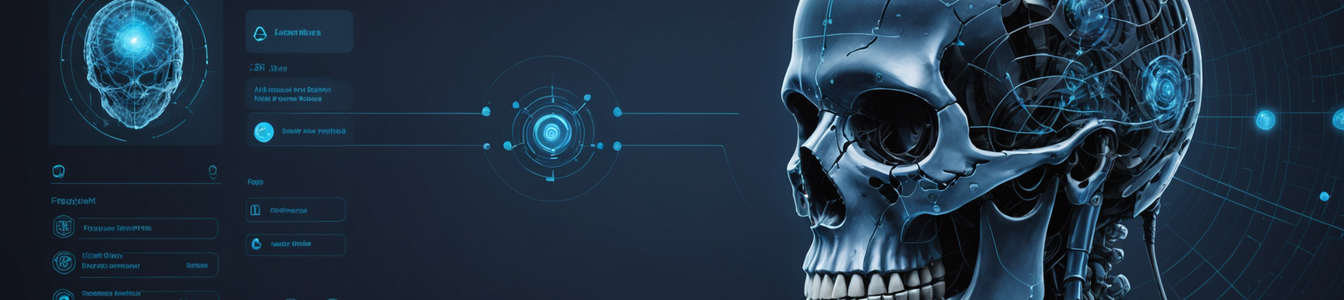
Emerging from research labs comes 'VitalID,' a novel authentication paradigm that moves beyond fingerprints, faces, and irises to something far more intrinsic: the unique vibrational signature of the human skull. The principle leverages bone conduction, the process by which sound waves travel through the cranial bones. Researchers have demonstrated that each individual's skull possesses distinct resonant properties—a product of its unique density, structure, and geometry.
The proposed system is elegantly contactless. A standard device speaker emits a specific, inaudible acoustic signal. This signal travels through the air, is absorbed by the user's head, and causes the skull to vibrate in its characteristic way. A microphone, potentially the same one used for voice calls, then captures these subtle, person-specific vibrations. Machine learning algorithms analyze this captured signal, comparing it to a previously enrolled reference pattern. A match grants access; a mismatch denies it.
The potential advantages are significant. Unlike passwords, it cannot be phished, guessed, or written down. Unlike facial recognition, it is not fooled by masks, photographs, or lighting conditions. It requires no dedicated hardware beyond existing speakers and microphones, making it potentially deployable on billions of smartphones and laptops overnight. It also addresses privacy concerns associated with facial biometrics, as the raw vibrational data is a complex waveform, not an immediately recognizable image of the user.
The Present Danger: Critical Flaws in Authentication Gatekeepers
While VitalID paints a picture of tomorrow's security, today's reality is underscored by critical vulnerabilities in the very systems that manage access to corporate networks. Cisco's recent emergency patches for its Identity Services Engine (ISE) and Security Server Manager (SSM) serve as a sobering counterpoint. These platforms are central to enterprise Zero Trust and network access control (NAC) strategies, acting as the arbiters of who and what can connect to sensitive resources.
The disclosed flaws, carrying the maximum severity rating of 9.8 on the CVSS scale, represent a worst-case scenario for defenders. They are remotely exploitable by unauthenticated attackers, meaning no prior foothold or credentials are needed. Successful exploitation could lead to a complete compromise of the system, allowing an attacker to execute arbitrary code with root privileges, steal sensitive credential databases, and bypass all authentication and authorization controls the system is meant to enforce.
The implications are profound. A compromised ISE server becomes a master key to the entire corporate kingdom. An attacker could create unauthorized admin accounts, downgrade security policies for targeted users, or simply disable security controls to facilitate lateral movement. This isn't just a breach of a single system; it's a breach of the central authentication authority itself.
The Arms Race in Context: Innovation vs. Exploitation
This juxtaposition is the essence of modern cybersecurity. On one flank, researchers and developers are in an arms race to create authentication methods that are more secure, convenient, and resistant to emerging threats like deepfakes or AI-powered password cracking. Biometrics like skull vibrations, gait analysis, and heartwave patterns represent the cutting edge of this effort, seeking to bind digital identity inextricably to the immutable physical self.
On the other flank, attackers are engaged in a parallel arms race to find and exploit vulnerabilities in the widely deployed, complex systems that form our current digital perimeter. High-value targets like Cisco ISE are subjected to constant scrutiny. The discovery of a 9.8-rated flaw is not an anomaly but an expected outcome of this relentless pressure.
Strategic Implications for Security Leaders
For CISOs and security teams, this dual narrative demands a balanced strategy:
- Vigilant Patch Management: The Cisco flaws are a clarion call for rigorous and rapid patch management processes, especially for critical infrastructure components like NAC and authentication servers. The window between patch release and exploit weaponization is often measured in days.
- Defense-in-Depth: No single authentication method, no matter how innovative, should be a silver bullet. A layered defense strategy that combines multiple factors (something you are, something you have, something you know) remains paramount. Even if VitalID matures, it should be part of a mosaic, not a standalone solution.
- Evaluating Emerging Tech: Security leaders must actively monitor advancements like skull biometrics. The questions shift from feasibility to practical implementation: How robust is it against spoofing? What is the false acceptance/rejection rate? How is the biometric template stored and protected? The promise must be weighed against rigorous testing.
- Architectural Resilience: The severity of the Cisco vulnerabilities highlights the risk of single points of failure in authentication architecture. Designing resilient systems with segmentation, robust monitoring of auth-server activity, and prepared incident response plans for their compromise is critical.
Conclusion
The journey from vulnerable passwords to vulnerable biometric sensors, and now to critical flaws in the policy engines that govern them all, shows that the attack surface constantly evolves. 'VitalID' represents a fascinating leap toward a more seamless and potentially secure future, moving authentication from something you remember or present to something you inherently are. Yet, the critical Cisco patches are a forceful reminder that the foundational systems managing our digital identities today remain under intense siege.
The true arms race is not a single sprint toward an unbreakable lock. It is a perpetual marathon on two tracks: inventing the locks of tomorrow while continuously reinforcing, patching, and defending the locks that secure our world today. The professionals who understand both tracks will be best positioned to navigate the challenging terrain ahead.
Comentarios 0
Comentando como:
¡Únete a la conversación!
Sé el primero en compartir tu opinión sobre este artículo.
¡Inicia la conversación!
Sé el primero en comentar este artículo.