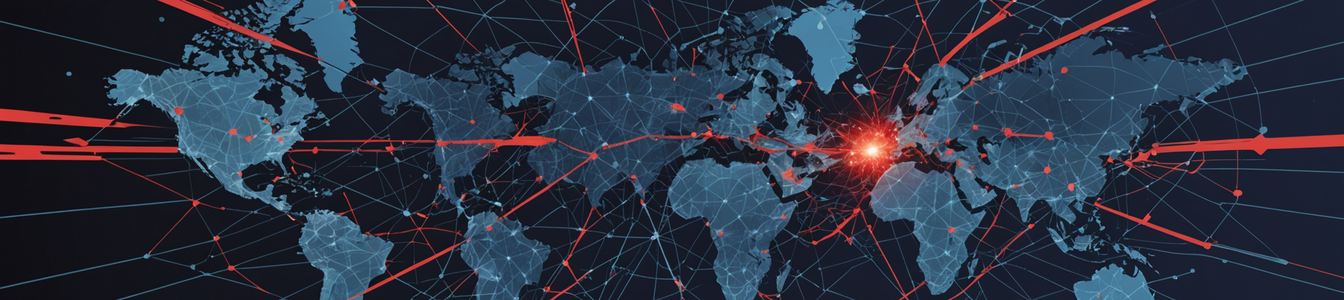
A seismic shift in US trade policy authority is sending shockwaves through global digital supply chains, creating unprecedented security challenges that extend far beyond traditional economic concerns. The US Supreme Court's recent decision to invalidate presidential tariff authority—a move strongly endorsed by former Vice President Mike Pence who emphasized that the Constitution places trade power squarely with Congress—has not brought policy clarity. Instead, it has inaugurated what security analysts are calling 'Policy Whiplash 2.0,' a period of intense judicial-executive conflict that fractures the predictability essential for securing complex digital ecosystems.
The Anatomy of Policy Whiplash
The ruling itself aimed to restore constitutional order, but its immediate effect has been policy chaos. With the executive branch's unilateral trade tool dismantled and President Trump threatening retaliatory measures against countries that 'play games,' organizations face a landscape of profound uncertainty. This instability is not merely a political or economic issue; it is a critical cybersecurity vulnerability. When policy directions can reverse abruptly based on court rulings, political statements, or retaliatory threats, the long-term security investments and architectures that protect digital supply chains become obsolete overnight.
Digital Supply Chains in the Crossfire
Digital supply chains—the interconnected networks of hardware manufacturers, software developers, cloud providers, and logistics systems—rely on stability. Security protocols are built around known trade routes, trusted vendor relationships, and predictable regulatory environments. The current whiplash forces companies to rapidly pivot sourcing, manufacturing, and data routing strategies. This accelerated realignment, often done under competitive pressure, leads to dangerous shortcuts: skipping thorough vendor security assessments, deploying untested integration protocols, and exposing data to jurisdictions with weaker cyber governance.
Specific sectors are already feeling the strain. Analysis of market movements indicates significant pressure on textile stocks, a sector deeply integrated with digital inventory, IoT-enabled manufacturing, and global e-commerce platforms. The 'next potential headwind' for these companies is not just economic; it's the compounded cyber risk from hastily altered supplier networks and the increased attack surface from new, less-vetted digital partners.
The Cybersecurity Implications of Forced Realignment
For cybersecurity teams, Policy Whiplash 2.0 manifests in several concrete threats:
- Third-Party Risk Explosion: Rapid vendor changes mean security teams cannot perform adequate due diligence. New suppliers in new countries may have unknown security postures, lack compliance with expected standards (like NIST or ISO 27001), or be subject to hostile nation-state influence.
- Geopolitical Threat Modeling Breakdown: Traditional threat models based on stable geopolitical alliances are obsolete. A partner country today could be a tariff-targeted adversary tomorrow, changing the risk profile of data stored or processed in that region. This ambiguity is exploited by advanced persistent threats (APTs) who thrive in confusion.
- Software Bill of Materials (SBOM) and Provenance Chaos: A core tenet of modern supply chain security is knowing the provenance of software components. When hardware manufacturing is shifted quickly to avoid tariffs, the firmware and embedded software within those components change origin, potentially introducing compromised or counterfeit elements into critical systems.
- Compliance and Data Sovereignty Nightmares: Data residency requirements (governed by laws like GDPR) clash with the need to move processing or storage to new locations. This can lead to inadvertent regulatory violations or force risky data transfer mechanisms.
The New Attack Vector: Policy Chaos Itself
Sophisticated threat actors, particularly state-sponsored groups, are now monitoring policy debates and court rulings as intelligence sources. They anticipate which industries or companies will be forced to make rapid digital transitions and preposition malware or launch phishing campaigns tailored to the confusion. A company scrambling to find a new semiconductor supplier is a perfect target for a Business Email Compromise (BEC) attack posing as a new vendor. The chaos itself is the vulnerability.
Mitigating the Whiplash: A Security-First Approach
Organizations cannot control geopolitics, but they can build resilience into their security posture:
- Dynamic Third-Party Risk Management: Move from periodic vendor assessments to continuous monitoring, especially for critical suppliers. Implement security ratings services that provide real-time insight into vendor cyber health.
- Agile Threat Intelligence: Integrate geopolitical and trade policy monitoring into threat intelligence feeds. Security Operations Centers (SOCs) should have context on how policy shifts alter the threat landscape for their specific industry.
- Modular Security Architecture: Design networks and data flows with agility in mind. Use micro-segmentation and zero-trust principles so that integrating a new partner or moving a workload does not require a full network re-architecture, reducing the temptation to bypass security controls for speed.
- Enhanced Software Supply Chain Scrutiny: Double down on SBOM generation and analysis. Any new hardware or software vendor resulting from a supply chain shift must undergo rigorous component provenance verification.
Conclusion: Security in an Age of Instability
The Supreme Court's ruling has fundamentally altered the digital risk calculus. The era of assuming stable trade policy as a backdrop for long-term security planning is over. In Policy Whiplash 2.0, the cybersecurity function must evolve from a technical protector to a strategic advisor, constantly assessing how judicial rulings, executive actions, and congressional maneuvers reshape the digital battlefield. The security of global digital trade now depends as much on interpreting legal opinions as on patching vulnerabilities. The organizations that will thrive are those that recognize policy instability not just as a business challenge, but as a first-order cybersecurity threat.
Comentarios 0
Comentando como:
¡Únete a la conversación!
Sé el primero en compartir tu opinión sobre este artículo.
¡Inicia la conversación!
Sé el primero en comentar este artículo.