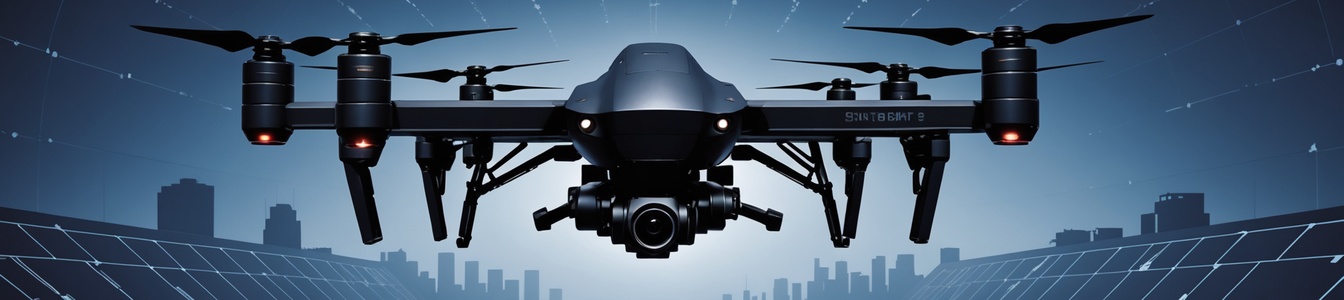
The race to secure critical communications against the next generation of cyber threats has entered a new, airborne phase. A European defense consortium has announced the successful field testing of what is believed to be the world's first quantum-resistant unmanned aerial vehicle (UAV) platform. This breakthrough represents a proactive leap in military cybersecurity, moving beyond defending against today's threats to fortifying systems against the cryptographic-breaking power of future quantum computers.
The Quantum Threat Horizon
For decades, the security of digital communications—from online banking to state secrets—has relied on public-key cryptography algorithms like RSA and Elliptic Curve Cryptography (ECC). Their strength lies in the computational difficulty of problems like integer factorization, which are virtually impossible for classical computers to solve in a reasonable timeframe. However, the advent of large-scale, fault-tolerant quantum computers, a technology still under development but advancing rapidly, threatens to upend this foundation. Quantum algorithms, particularly Shor's algorithm, could solve these mathematical problems exponentially faster, rendering current encryption obsolete. This 'harvest now, decrypt later' threat, where adversaries collect encrypted data today to decrypt it once quantum computers are available, has made post-quantum cryptography (PQC) a global priority.
The Quantum-Safe Drone: A Technical Milestone
The recently tested drone platform integrates a PQC solution directly into its command, control, and communications (C3) link. Reports indicate the system utilizes the Classic McEliece cryptosystem, a front-runner in the global PQC standardization process led by the U.S. National Institute of Standards and Technology (NIST). Classic McEliece is a code-based algorithm, considered secure against attacks from both classical and quantum computers due to the inherent difficulty of decoding random linear codes. Its selection highlights a focus on long-term security assurance, despite typically larger key sizes compared to traditional algorithms.
The technical achievement is not merely the use of PQC in a lab setting but its operationalization in a constrained, mobile environment. Drones have limited power, processing capacity, and bandwidth. Successfully implementing a computationally intensive cryptographic protocol in real-time on such a platform required significant optimization and hardware-software co-design. This proves the feasibility of 'crypto-agile' architectures in field-deployable military hardware, allowing for cryptographic algorithms to be updated as threats evolve without replacing entire systems.
Strategic Implications and the Defense Landscape
This development is more than a technical demo; it is a strategic signal. Nations and defense contractors are engaged in a dual race: to achieve quantum supremacy and to quantum-harden their most sensitive assets. By deploying a quantum-resistant drone, the European consortium is addressing a critical vulnerability. Military drones are intelligence, surveillance, and reconnaissance (ISR) workhorses, and a compromised C3 link could lead to loss of assets, intercepted data, or even hijacked operations.
The move pushes the entire defense ecosystem toward future-proofing. It sets a precedent that new procurements, especially for systems with long lifecycles like satellites, naval vessels, and communication infrastructure, must evaluate PQC integration. For cybersecurity professionals in the defense sector, this underscores an urgent need to inventory cryptographic dependencies, assess the risk of 'cryptographic collapse,' and develop migration plans to hybrid or fully post-quantum systems.
Broader Impact on Cybersecurity
While the application is military, the implications ripple across the entire cybersecurity domain. The successful test provides a tangible use case for PQC migration in IoT and constrained devices, a category that includes everything from industrial sensors to connected vehicles. It validates that performance hurdles can be overcome.
For the global cybersecurity community, this announcement is a clarion call. The quantum clock is ticking. Organizations protecting critical infrastructure, financial data, and health records cannot afford to wait. The work on cryptographic agility—building systems that can easily switch out cryptographic primitives—must accelerate. The drone serves as a proof-of-concept that migration is possible, even in challenging environments.
The Road Ahead
The path to a quantum-safe world is complex. NIST's PQC standardization process is ongoing, and final standards are expected soon. Interoperability between different systems and algorithms will be a major challenge. Furthermore, PQC algorithms themselves will require continuous scrutiny for new classical or quantum attacks.
However, the deployment of a quantum-resistant drone marks a definitive shift from theoretical research and standardization debates to practical implementation. It demonstrates that the foundational work to secure our digital future against the quantum threat is not only necessary but now achievable. As nation-states and private entities continue to advance quantum capabilities, such proactive defenses will become the benchmark for resilience, transforming how we build and trust the connected systems of tomorrow.
Comentarios 0
Comentando como:
¡Únete a la conversación!
Sé el primero en compartir tu opinión sobre este artículo.
¡Inicia la conversación!
Sé el primero en comentar este artículo.