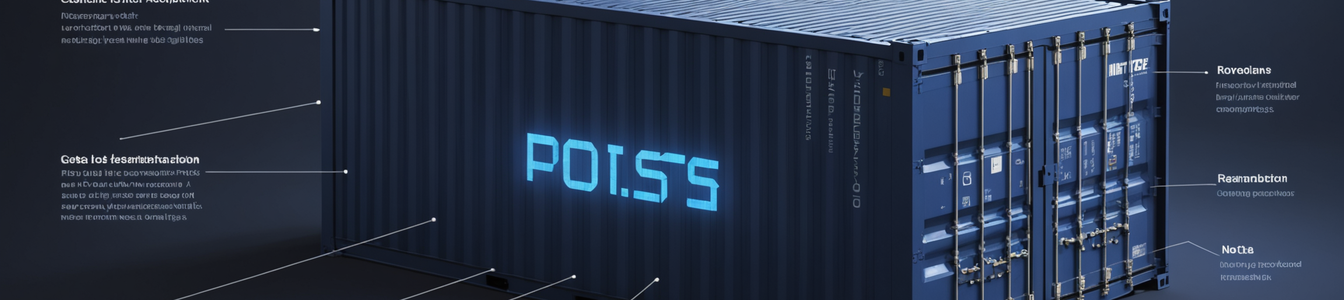
A quiet but seismic shift is occurring in the foundational infrastructure of global trade, with profound implications for cybersecurity. Buried within India's 2026 Union Budget is a ₹10,000 crore (approximately $1.2 billion) allocation aimed at breaking China's stranglehold on shipping container manufacturing. This geopolitical maneuver, designed to secure physical supply chains, simultaneously creates a vast new digital attack surface that security teams worldwide must now prepare to defend.
The Geopolitical Container Monopoly
China currently manufactures over 95% of the world's shipping containers—the standardized steel boxes that carry roughly 90% of global non-bulk cargo. This dominance represents a critical single point of failure, not just logistically but digitally. India's massive financial push aims to cultivate a complete domestic ecosystem for container production, from steel procurement to final assembly. The initiative is a direct response to pandemic-era shortages and geopolitical tensions that highlighted the risks of over-reliance on a single nation for critical infrastructure. As articulated in budget documents, the goal is to enhance India's maritime resilience and economic sovereignty. However, the cybersecurity ramifications extend far beyond national borders.
From Steel Boxes to Smart Attack Vectors
The modern shipping container is no longer a 'dumb' metal box. The next generation—which India's initiative will inevitably produce—are 'smart containers.' These are equipped with IoT sensors for real-time tracking of location, temperature, humidity, shock, and even unauthorized access. This digital layer transforms a physical asset into a node on a vast, global network.
The cybersecurity risks manifest in several layers:
- Hardware Integrity & Firmware Backdoors: Domestically manufactured containers require electronic seals, GPS modules, and sensor suites. The supply chain for these components—from microcontrollers to communication chips—becomes a target for state-sponsored or criminal tampering. A backdoor implanted at the manufacturing stage could allow for tracking spoofing, data exfiltration on cargo contents, or even the creation of a botnet from thousands of distributed container nodes.
- IoT Ecosystem Vulnerabilities: The network of smart containers forms a massive, mobile IoT deployment. Historically, IoT security has been an afterthought, with devices often featuring weak default credentials, unpatched vulnerabilities, and insecure communication protocols. A fleet of hundreds of thousands of containers could be hijacked to create a distributed denial-of-service (DDoS) network or used as a bridge to attack the more secure IT networks of shipping lines and port authorities.
- Software-Defined Logistics & Supply Chain Poisoning: The value of smart containers lies in their integration into logistics software platforms. Compromising the software that aggregates and analyzes container data—through vulnerabilities in APIs, data pipelines, or cloud services—could enable widespread cargo theft, fraud, or disruption. An attacker could manipulate sensor data to falsely report spoilage of perishable goods or hide the diversion of high-value shipments.
- The Port IT/OT Convergence Challenge: Smart containers will interface directly with port operational technology (OT) systems during loading, unloading, and inspections. This erodes the traditional air-gap between IT and OT networks, creating new pathways for cyber-physical attacks. A compromised container's system could be used as an initial access point to attack critical port infrastructure, such as crane control systems or gate logistics.
The Broader Security Landscape: A Pattern of Decoupling
India's container push is not an isolated event. It is part of a broader, global trend of 'strategic decoupling' and supply chain diversification, evident in parallel budget boosts for semiconductors, rare earth minerals processing, and defense manufacturing. Each new domestic supply chain represents a new ecosystem that must be secured from the ground up. The challenge for India—and a lesson for other nations following a similar path—is to implement 'security-by-design' principles from the outset. This means mandating hardware security modules (HSMs) for data authentication, ensuring secure over-the-air (OTA) firmware update mechanisms, and establishing rigorous standards for the software bill of materials (SBOM) for all container management systems.
Recommendations for Cybersecurity Leaders
For CISOs and security teams in logistics, manufacturing, and critical infrastructure, India's move signals the need for proactive measures:
- Expand Threat Modeling: Include smart logistics assets and their software platforms in organizational threat models. Assume these interconnected systems will be targeted.
- Audit Third-Party IoT Risk: Scrutinize the cybersecurity posture of vendors providing smart container solutions. Demand transparency on hardware provenance, firmware development practices, and vulnerability management programs.
- Segment Network Access: Enforce strict network segmentation policies to isolate container IoT networks from core corporate and industrial control system (ICS) networks, while still allowing necessary data flow.
- Monitor for Anomalous Behavior: Deploy security solutions capable of detecting anomalies in the massive data streams generated by smart containers, such as unexpected geographical locations, improbable sensor readings, or unusual communication patterns.
Conclusion: Security as a Foundational Element of Sovereignty
India's $1.2 billion bet is a clear statement: economic sovereignty in the 21st century requires digital sovereignty. The security of the physical containers—the workhorses of globalization—will be determined by the integrity of their digital components and the software that governs them. As nations race to rebuild resilient supply chains, cybersecurity must be the bedrock, not an afterthought. The 'Geopolitical Container Wars' have begun, and their first battles will be fought not on the high seas, but in silicon, code, and secure network design.
Comentarios 0
Comentando como:
¡Únete a la conversación!
Sé el primero en compartir tu opinión sobre este artículo.
¡Inicia la conversación!
Sé el primero en comentar este artículo.