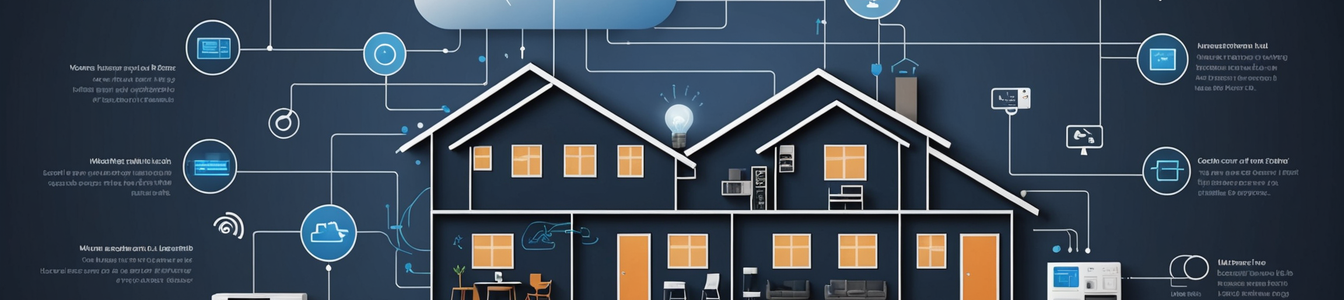
The vision of a seamlessly connected, intelligent home is giving way to a more complex reality: a battlefield of competing architectures. As we move into 2026, the smart home industry is not just fragmented by brand loyalty or communication protocols like Zigbee and Matter; it is fundamentally divided by philosophy. This schism—between cloud-dependent ecosystems and local-control advocates—carries profound implications for security, privacy, and resilience, forcing consumers and cybersecurity experts to choose not just a product, but a security model.
The Cloud Colossus: Convenience at a Cost
The mainstream trajectory, exemplified by tech giants, remains firmly cloud-centric. Samsung's planned unveiling of a new AI-Connected Living lineup at CES 2026 signals a deepening commitment to this model. These platforms leverage powerful cloud AI to deliver predictive automation, unified voice control, and sophisticated analytics. The user experience is often polished and simple, requiring minimal technical setup.
From a security perspective, however, this model centralizes risk. Every command, sensor reading, and video feed typically traverses the vendor's servers. This creates a high-value target for attackers and places immense trust in the vendor's security posture, data handling policies, and resilience against outages. A breach at the cloud level could potentially expose data from millions of homes. Furthermore, these systems often become 'bricks' during internet downtime, stripping users of basic automation and control. The privacy trade-off is explicit: data is the currency for advanced features.
The Local-First Rebellion: Security Through Sovereignty
In direct opposition stands the burgeoning 'local-first' movement, championed by open-source platforms like Home Assistant. This philosophy prioritizes keeping data and processing within the home's local network. Devices communicate directly with a local hub or server, which can run on commodity hardware like a Raspberry Pi or a dedicated appliance. Internet access becomes optional for core functionality, used primarily for remote access via secure methods like VPNs or for integrating external services.
The security advantages are compelling. The attack surface shrinks dramatically; there is no central cloud database to hack. Data privacy is inherently stronger as personal routines and device states never leave the premises. Resilience is enhanced—local automations for lighting, climate, and security continue to function even if the broadband connection fails. For cybersecurity-aware users, this represents a more defensible architecture.
The New Contender: Bridging the Gap?
The landscape is now seeing new entrants aiming to refine this local model. Homey's move to challenge Home Assistant with a new software-only smart home solution represents an evolution. By decoupling the platform from proprietary hardware and offering it as software, it potentially lowers the barrier to entry for local control while seeking to provide a more polished user experience. The goal appears to be making local-first systems more accessible to users who are security-conscious but not necessarily DIY experts.
This development highlights a maturation within the local-control segment, focusing on usability without sacrificing core security tenets. The success of such platforms depends on their ability to maintain security transparency, support secure local communication protocols, and avoid covert cloud dependencies.
Cybersecurity at the Crossroads
For cybersecurity professionals advising clients or assessing organizational risks (including remote work environments), this fragmentation requires a nuanced analysis:
- Risk Assessment Models Must Evolve: Evaluating a smart home device can no longer end at its password policy or update frequency. The primary question must be: "What is its operational architecture?" The risk profile of a cloud-mandatory device is fundamentally different from that of a local-only one.
- The Configuration Complexity Challenge: Local-first systems often transfer security responsibility to the end-user. Secure setup of a local network, managing VPNs for remote access, and ensuring the host device (e.g., a server) is patched require higher technical competency. Poor configuration could negate the inherent architectural advantages.
- Supply Chain and Longevity Risks: Cloud-dependent devices face 'sunsetting' risks—when vendors discontinue services, devices lose functionality. Local systems are generally future-proofed from this but depend on community or developer support for integration updates.
- The Matter Protocol's Ambiguous Role: While the new Matter standard promises interoperability, its security model still often relies on cloud-based 'fabric' management for remote access, not fully resolving the core architectural debate.
Conclusion: Architecture as a Security Feature
The great smart home schism is, at its heart, a debate over where trust and control should reside. The cloud model offers convenience and power but asks users to trust a corporation with their domestic data. The local model offers sovereignty and resilience but demands more technical engagement. For the security community, this means advocacy and education are crucial. Guiding consumers and businesses involves explaining these trade-offs clearly: the smart home is no longer just about features; it's about foundational security architecture. The choice between a cloud gateway and a local hub is becoming one of the most significant security decisions a homeowner can make.
Comentarios 0
Comentando como:
¡Únete a la conversación!
Sé el primero en compartir tu opinión sobre este artículo.
¡Inicia la conversación!
Sé el primero en comentar este artículo.