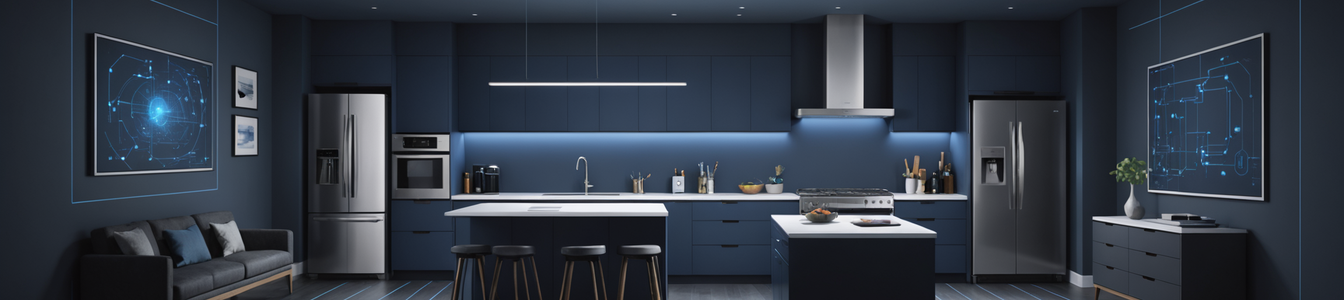
The narrative at CES has long been dominated by flashy screens and audible assistants. At CES 2026, however, the most significant story was one you couldn't see or hear. A quiet revolution in passive sensing technology has moved from labs and niche prototypes to the mainstream smart home floor, promising a camera-free future while simultaneously constructing an invisible web of pervasive data collection. This shift, led by technologies like Ultra-Wideband (UWB), millimeter-wave (mmWave) radar, and WiFi Sensing, presents a profound new frontier for cybersecurity and privacy professionals.
Beyond the Lens: The New Sensing Trinity
The driving force behind this revolution is a trio of technologies that infer presence and context without a single pixel. Aqara, a major smart home player, showcased this shift comprehensively. Their new UWB smart lock represents a turning point, using precise radio wave timing to detect a user's approach and unlock doors with sub-10-centimeter accuracy, all from a smartphone or fob. More intriguing, however, was their latest mmWave-based presence sensor. This 'blind' device uses high-frequency radio waves to detect not just if a room is occupied, but nuanced states like whether a person is sitting, standing, lying down, or even napping. It can distinguish between a pet and a human and map micro-movements like breathing.
Parallel to this, the collaboration between Origin AI and Synaptics aims to bake WiFi Sensing directly into router chipsets and smart home devices. This technology repurposes existing WiFi signals to detect movement, presence, and even falls by analyzing perturbations in the wireless signal. The promise is a whole-home sensing mesh without any dedicated hardware beyond the router.
The Privacy Paradox: Invisible but Omniscient
The marketing angle is compelling: "No cameras, more privacy." And technically, it's true. These sensors don't capture identifiable visual data. But for cybersecurity experts, this presents a more insidious privacy paradox. The data generated—precise location within a home, activity patterns, sleep cycles, respiratory rates—constitutes a form of behavioral biometrics far more intimate than a blurry camera feed. It creates a continuous, ambient log of private life.
Unlike a camera, which has a visible lens and often an indicator light, these sensors offer no obvious sign they are active. A user might never know a mmWave sensor in a light switch is tracking their posture or that their router is analyzing their movement patterns. This lack of transparency and clear user consent mechanism is a fundamental security and privacy flaw.
The Cybersecurity Threat Landscape Expands
The proliferation of these sensors dramatically expands the attack surface for the smart home. Each sensor becomes a new data source, a new node in the IoT network that must be secured. The threats are multi-layered:
- Data Interception and Exfiltration: The streams of sensitive behavioral data must be encrypted in transit and at rest. A breach could reveal not just when a home is empty, but the daily routines, health indicators, and intimate behaviors of its inhabitants.
- Sensor Spoofing and Manipulation: Could an attacker mimic the radio signature of an authorized UWB key? Could they inject noise into a WiFi Sensing system to create a false "empty house" reading for a burglary? The integrity of these sensing systems is critical for physical security applications like locks.
- The Aggregated Profile Risk: Individually, a sensor knowing you're in the living room is minor. But aggregated across dozens of devices—from locks, lights, routers, and sensors—a detailed, real-time profile of a person's life can be constructed. This aggregated dataset is a high-value target for malicious actors, advertisers, or insurers.
- Supply Chain and Firmware Vulnerabilities: As seen with the Origin AI-Synaptics partnership, this sensing capability is moving into silicon. Firmware vulnerabilities in these embedded systems could be widespread and difficult to patch, creating a persistent risk.
The Path Forward: Security by Ambient Design
The industry is rushing toward convenience and context-awareness. The cybersecurity community must now rush to establish frameworks for what "security" means in an ambiently intelligent world. This includes:
- Mandatory Transparency: Devices must have clear, non-technical indicators of active sensing and the type of data being collected.
- Granular User Control: Users need easy-to-access controls to disable sensing features entirely or for specific time periods, not buried in complex app menus.
- Data Minimization and On-Device Processing: Where possible, sensitive analysis (e.g., "person is falling") should occur on the device itself, with only essential alerts—not raw signal data—sent to the cloud.
- Strong Authentication and Encryption: Communication between sensors and hubs must use modern, robust cryptographic standards to prevent interception and spoofing.
- Regulatory Scrutiny: Existing data protection regulations like GDPR and CCPA may not adequately cover this form of non-visual, behavioral inference. New guidelines specific to ambient sensing are likely needed.
CES 2026 revealed that the smart home is evolving from being reactive to being anticipatory. It seeks to understand context without being asked. For cybersecurity, the task is to ensure this quiet revolution in sensing does not become a loud crisis in privacy and security. The ambient spy must be kept on a very short, very secure leash.
Comentarios 0
Comentando como:
¡Únete a la conversación!
Sé el primero en compartir tu opinión sobre este artículo.
¡Inicia la conversación!
Sé el primero en comentar este artículo.