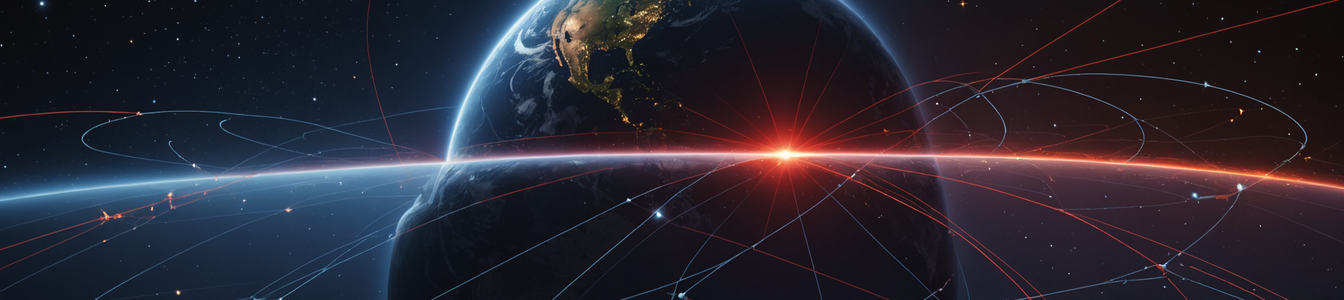
A silent revolution is unfolding 500 kilometers above our heads. Low Earth Orbit (LEO), once the exclusive domain of multi-billion-dollar government space agencies, is being rapidly industrialized. Fueled by a convergence of technological advancement and geopolitical ambition, a multi-hundred-billion-dollar investment rush is transforming this orbital band into what experts now call the "new critical infrastructure frontier." For cybersecurity professionals, this represents not just a new domain to understand, but a fundamentally new and vulnerable attack surface with global implications.
The investment drivers are clear and powerful. Commercial entities, led by tech giants like SpaceX (with its Starlink constellation of over 5,000 satellites), Amazon's Project Kuiper, and OneWeb, are racing to deploy mega-constellations. Their primary goal is to provide ubiquitous, low-latency broadband internet, bridging the digital divide and creating new data markets. Simultaneously, governments are pouring resources into LEO for next-generation intelligence, surveillance, and reconnaissance (ISR), secure military communications, and early-warning systems. The recent reported positioning of advanced UK nuclear-powered submarines in strategic regions underscores the growing reliance on space-based assets for terrestrial military dominance and rapid response capabilities. These submarines, and the forces they support, depend on LEO constellations for secure, real-time communication and targeting data.
This dual-use nature of LEO infrastructure—hosting both civilian broadband satellites and critical national security assets—creates a complex and perilous risk landscape. The cybersecurity challenges are unprecedented and stem from several inherent architectural vulnerabilities:
- Expanded Attack Surface: A single mega-constellation comprises thousands of individual satellites, each a potential entry point. The attack surface extends from the satellite's onboard software and hardware to its command uplinks and downlinks, the inter-satellite laser links forming a space-based mesh network, and the globally distributed ground station network.
- Inherent Physical Inaccessibility: Unlike a compromised server in a data center, a satellite cannot be physically "rebooted" or have its hardware replaced after a cyber intrusion. A successful attack could lead to a permanent loss of a multi-million-dollar asset or, worse, its transformation into hostile space debris.
- The Convergence Threat: The proximity of commercial and military satellites in LEO creates a dangerous blurring of lines. An adversary could target a commercial satellite to test offensive capabilities, create strategic ambiguity, or even cause a kinetic collision that generates debris fields threatening nearby government assets—a form of "dual-use" asymmetric warfare.
- Supply Chain Complexity: The supply chain for satellite components is global and opaque. Backdoors or vulnerabilities implanted in commercial off-the-shelf components, software libraries, or even in the launch vehicle's systems could lie dormant until activated, compromising the entire constellation's integrity from within.
Potential attack vectors are evolving from theoretical to imminent. Threat actors could seek to hijack satellite command channels to redirect or disable assets, jam or spoof signals to disrupt communications and GPS-dependent critical infrastructure (like financial timestamping or power grids), or deploy malware that propagates across the constellation via inter-satellite links. A sophisticated attack could turn satellites into weapons of mass disruption, crippling global logistics, financial transactions, and emergency services.
The geopolitical stakes are immense. Control over LEO is increasingly viewed as a prerequisite for economic and military superiority. The lack of clear international norms and treaties governing cyber operations in space creates a legal gray zone ripe for escalation. Incidents may be difficult to attribute, and the line between an act of cyber espionage and an act of war becomes dangerously thin when targeting national security satellites.
For the cybersecurity community, the LEO boom demands urgent action and a new mindset. Defending this frontier requires:
- Space-Specific Threat Intelligence: Developing dedicated teams that understand orbital mechanics, satellite protocols (like CCSDS), and the unique TTPs (Tactics, Techniques, and Procedures) of space-borne threats.
- Zero-Trust Architectures for Orbit: Implementing strict authentication, encryption, and segmentation for all communications between ground, satellite, and intersatellite links, assuming the network is always hostile.
- Resilience by Design: Building constellations with autonomous cyber-defense capabilities, redundancy, and the ability to isolate compromised nodes to prevent lateral movement.
- Public-Private Collaboration: Fostering unprecedented cooperation between commercial satellite operators and national defense agencies to share threat data and establish common security baselines.
The race for LEO is a race for the future. As this orbital layer becomes woven into the fabric of our daily lives and national security, securing it is no longer optional. Cybersecurity must lift its gaze from the terrestrial horizon to the stars, preparing to defend the next—and perhaps most critical—domain of human endeavor.
Comentarios 0
Comentando como:
¡Únete a la conversación!
Sé el primero en compartir tu opinión sobre este artículo.
¡Inicia la conversación!
Sé el primero en comentar este artículo.