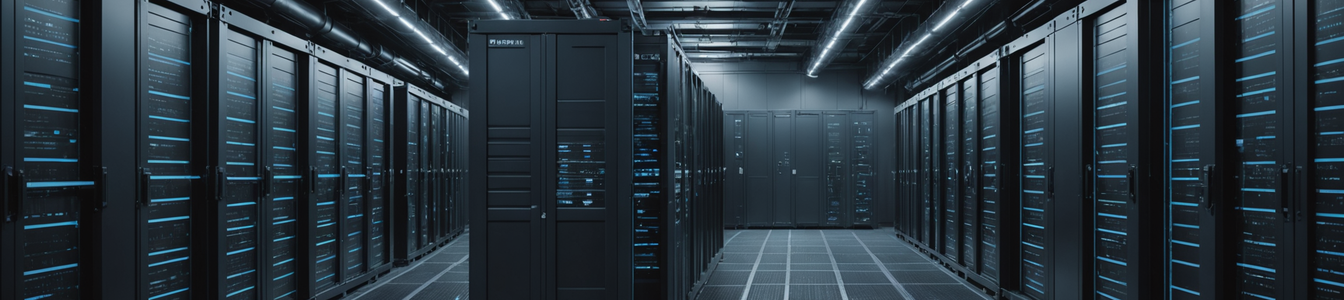
The ethereal concept of "the cloud" is being pulled firmly down to earth. Behind every virtual machine, every SaaS application, and every streaming service lies a vast, interconnected network of physical hardware. Today, that physical backbone is undergoing a radical redesign, driven by unprecedented efficiency in global shipping and a fundamental shift in how data centers are built. This convergence is not just an operational story; it's a critical evolution that cybersecurity strategies must immediately address.
The Logistics Engine: Ports Hitting Hyperdrive
The first pillar of this shift is the staggering throughput now achieved by global logistics hubs. Recent milestones underscore this acceleration. Adani Ports and Special Economic Zone (APSEZ) in India reported handling over 500 million metric tons (MMT) of cargo in the fiscal year 2026, a record fueled by a particularly strong performance in March. This isn't an isolated case. At DP World's terminal in Cochin, a single vessel operation recently managed to move 8,000 twenty-foot equivalent units (TEUs), setting a new benchmark for efficiency at the port. Meanwhile, the container shipping industry itself, represented by companies like MPC Container Ships, is experiencing a sustained upswing, indicating robust global demand for containerized transport.
These are not mere statistics for financial analysts. For the tech industry, they represent the proven capability to move immense volumes of standardized containers—the same units now repurposed for technology—anywhere in the world with speed and predictability. The global supply chain has become a high-capacity digital artery.
The New Data Center: From Cathedral to Shipping Container
The second, parallel transformation is in the architecture of the data center itself. The industry is moving away from monolithic, bespoke facilities that take years to plan and build. The new paradigm is the modular, prefabricated, containerized data center. Dubbed "Lego data centers" for their plug-and-play nature, these units are fully functional data halls—complete with servers, cooling, and power distribution—built inside standard ISO shipping containers in a factory.
This methodology offers compelling business advantages: rapid deployment (from months to weeks), scalability by simply adding more containers, and the flexibility to place computing power closer to users or data sources at the edge. However, this shift from a fixed, fortress-like facility to a mobile, standardized asset fundamentally alters its security profile.
Convergence and the New Cybersecurity Frontier
The intersection of these two trends—hyper-efficient logistics and portable data centers—creates a new physical-digital attack surface that legacy security models are ill-equipped to handle. Cybersecurity must now extend its purview to the entire hardware lifecycle.
- The Extended Supply Chain Attack Surface: A traditional data center is built on-site. A containerized unit is manufactured, integrated, tested, shipped, stored, transported, and finally deployed. Each handoff—from factory to freight forwarder, from port to trucking company—is a potential point of compromise. A malicious actor could intercept a container to implant hardware backdoors, tamper with firmware, or install skimming devices long before it reaches its destination. The integrity of the hardware supply chain is no longer just about counterfeit chips; it's about the physical custody of the entire data center module.
- The Vulnerability of Logistics Software: The tracking and management of these high-value containers rely on a complex web of software: Terminal Operating Systems (TOS), Transportation Management Systems (TMS), and IoT tracking devices. A breach in these systems, often operated by third-party logistics providers, could allow attackers to reroute a container, falsify its location or integrity status (e.g., temperature, shock), or simply make it disappear. Cyber-physical attacks targeting port infrastructure, as seen in past incidents, could disrupt the delivery of critical cloud capacity.
- Physical Security in Transit: A standard ISO container is not a secure vault. While in transit or temporarily stored in a port yard, these units, packed with millions of dollars worth of IT equipment, are vulnerable to physical theft, tampering, or the attachment of surveillance devices. The security model must assume a hostile transit environment.
- Standardization as a Risk: The "Lego" advantage is also a potential weakness. Standardized designs and components could allow attackers to develop targeted exploits that work across multiple deployments from the same vendor. A vulnerability in the integrated power or cooling control system, common to thousands of modules, becomes a mass-scale threat.
Building a Resilient Future: Security for the Mobile Cloud
Addressing these challenges requires a collaborative, layered approach:
- Hardware Root of Trust & Secure Provisioning: Every critical component within a containerized data center must be equipped with a hardware-based root of trust. Automated, zero-touch provisioning protocols should verify the integrity of all firmware and software upon first boot at the deployment site, rejecting any module that fails the check.
- Tamper-Evident & Tamper-Resistant Design: Physical containers need built-in sensors for intrusion detection, GPS tracking with geofencing, and seals that provide clear evidence of tampering. Data from these sensors must be cryptographically signed and transmitted via secure channels.
- Enhanced Visibility for Security Teams: Cybersecurity operations centers (SOCs) must have a unified dashboard that includes the physical logistics status of their infrastructure assets. Security Information and Event Management (SIEM) systems should ingest data from logistics IoT sensors, correlating physical events (e.g., an unexpected route deviation) with potential digital threats.
- Third-Party Risk Management on Steroids: Vetting cloud providers must now include rigorous assessment of their hardware supply chain and logistics partners. Contracts must enforce specific security standards for transportation, storage, and handling.
Conclusion
The cloud is becoming physical, modular, and mobile. The records being set in global ports are not just economic indicators; they are enablers of this new era. For cybersecurity, the mandate is clear: the security perimeter must expand to cover the thousands of miles of global supply chain that the physical cloud now travels. Protecting the data means securing the box it comes in, the ship that carries it, and the software that tracks it. The resilience of our digital future depends on hardening this new, mobile backbone.
Comentarios 0
Comentando como:
¡Únete a la conversación!
Sé el primero en compartir tu opinión sobre este artículo.
¡Inicia la conversación!
Sé el primero en comentar este artículo.