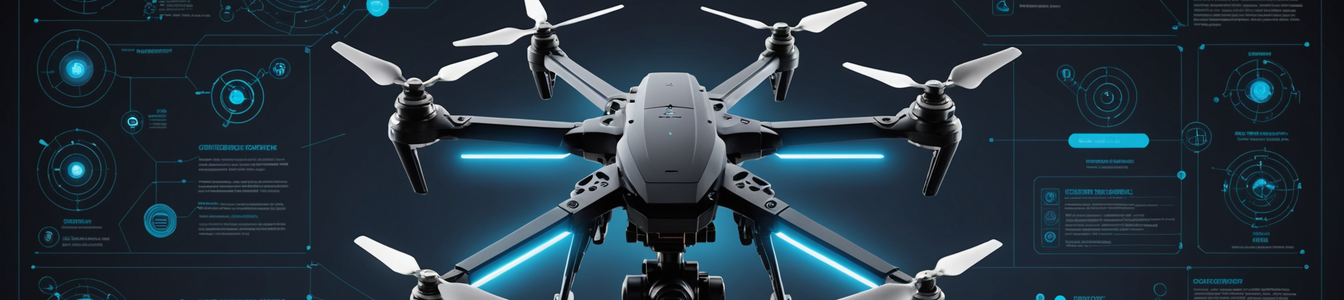
A recent procurement announcement has cast a spotlight on the evolving and precarious cybersecurity landscape of modern military operations. Defense technology firm EagleNXT has confirmed the successful sale of an advanced drone and integrated sensor package to the U.S. Army. This transaction is far more than a simple equipment sale; it represents a critical node in the militarization of the Internet of Things (IoT), creating what analysts term the "Battlefield IoT." This network of interconnected drones, sensors, ground stations, and command centers offers unparalleled capabilities but also presents a target-rich environment for adversaries, elevating cybersecurity from a support function to a core determinant of mission success and soldier safety.
The integration of sophisticated UAS into military networks exponentially increases the attack surface. Each drone is not an isolated system but a flying data node, continuously collecting, processing, and transmitting sensitive intelligence, surveillance, and reconnaissance (ISR) data. The sensor packages, which likely include electro-optical/infrared (EO/IR) cameras, signals intelligence (SIGINT) collectors, and potentially LiDAR, generate vast streams of data. The integrity of this data is paramount. A sophisticated cyberattack could subtly alter sensor feeds, providing false imagery or misleading signals intelligence. This "data poisoning" could lead to catastrophic decisions based on fabricated battlefield conditions, making data integrity validation a primary security challenge.
Perhaps the most acute vulnerability lies in the command-and-control (C2) link. These radio frequency (RF) or satellite communications (SATCOM) channels are the lifeline between the operator and the drone. They are susceptible to a range of offensive cyber and electronic warfare tactics. Adversaries can employ jamming to deny control (a denial-of-service attack on the physical layer) or, more insidiously, GPS spoofing and link hijacking to seize control of the asset. A captured drone can be turned into a weapon, used for reconnaissance against its former owners, or crashed to cause loss of a high-value asset. Securing these links requires advanced encryption, frequency hopping, and cryptographic authentication protocols that can operate in contested electromagnetic environments.
The EagleNXT deal also brings the issue of supply chain security into sharp focus. Modern defense systems are built with components sourced from a global network of suppliers. A vulnerability or malicious backdoor (a "hardware Trojan") introduced at any point in this chain—from a microchip manufacturer to a software subcontractor—can compromise the entire system. The use of Commercial Off-The-Shelf (COTS) technology, while reducing costs and accelerating deployment, often incorporates software and hardware with known vulnerabilities that may not meet rigorous military security standards. A comprehensive Supply Chain Risk Management (SCRM) program, involving rigorous vetting, code audits, and hardware validation, is no longer optional but a foundational element of military IoT security.
For the cybersecurity community, this evolution demands a shift in mindset and skill sets. Defending the Battlefield IoT requires convergence of IT security, operational technology (OT) security, and electronic warfare expertise. Security frameworks must adopt a "zero-trust" architecture, where no node or data transmission is inherently trusted, and verification is continuous. Network segmentation is crucial to ensure a breach in one sensor node does not cascade to the entire command network. Furthermore, resilience must be designed into systems, enabling drones to execute pre-programmed fail-safe protocols or return-to-home functions if their C2 link is severed or compromised.
The path forward involves several key initiatives. First, the development and mandatory implementation of strong, quantum-resistant encryption standards for all data-in-transit and data-at-rest within military IoT ecosystems. Second, investment in automated threat detection systems that use artificial intelligence to identify anomalous behavior in drone swarms or sensor networks indicative of a cyber intrusion. Third, continuous "red teaming" exercises where cybersecurity professionals actively attempt to hack these systems to find and fix flaws before adversaries do.
In conclusion, the EagleNXT contract is a microcosm of a larger, irreversible trend. The fusion of drones, sensors, and networked systems is defining a new era of connected warfare. The side that masters not only the technology but also its cybersecurity will hold a decisive advantage. Protecting the Battlefield IoT is now synonymous with protecting national security, requiring unprecedented collaboration between defense contractors, cybersecurity firms, and military cyber commands to secure every link in this critical chain.
Comentarios 0
Comentando como:
¡Únete a la conversación!
Sé el primero en compartir tu opinión sobre este artículo.
¡Inicia la conversación!
Sé el primero en comentar este artículo.