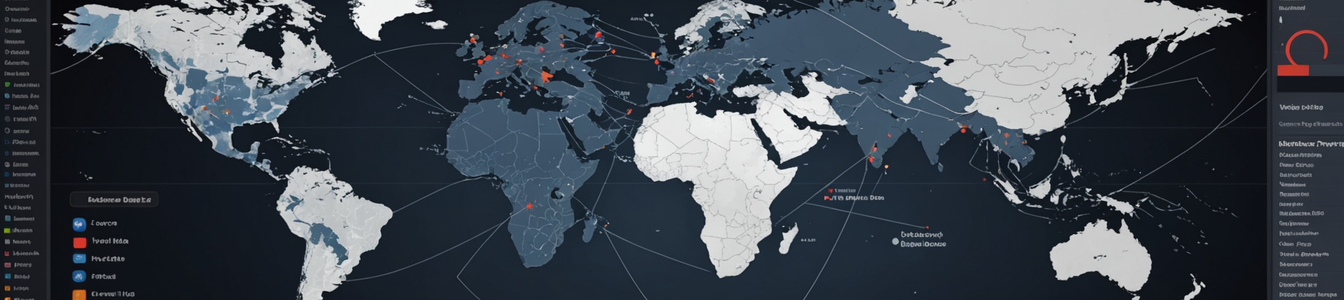
The Prediction Market Paradox: How Geopolitical Betting Creates Insider Threat Vectors and Market Manipulation
In an unprecedented move that has sent shockwaves through both cybersecurity and financial regulatory circles, the White House has formally warned all staffers against participating in prediction markets related to ongoing geopolitical conflicts, specifically citing the Iran war scenario. This directive, reported by multiple international news outlets, represents the first major institutional recognition of prediction markets as a legitimate national security and insider threat concern.
The warning specifically targets platforms like Polymarket, where users can place cryptocurrency-based bets on real-world outcomes ranging from election results to military conflicts. While framed as an ethics and conflict-of-interest measure, cybersecurity professionals recognize the deeper implication: prediction markets have evolved from novelty gambling platforms into sophisticated intelligence-gathering and market-manipulation tools that bypass traditional financial and security controls.
The Insider Threat Vector Redefined
What makes prediction markets uniquely dangerous from a cybersecurity perspective is their decentralized nature and cryptocurrency foundation. Unlike traditional financial markets with Know Your Customer (KYC) regulations and transaction monitoring, many prediction platforms operate with pseudonymous wallets, making it nearly impossible to trace whether a government employee with classified information is placing bets based on insider knowledge.
"This creates a perfect storm for insider threats," explains Dr. Elena Rodriguez, a former NSA analyst now specializing in financial cybersecurity. "An employee with access to classified conflict intelligence could theoretically place a bet through a privacy-focused cryptocurrency wallet, collect winnings with minimal traceability, and create what appears to be merely an accurate prediction. The traditional red flags of large bank transfers or suspicious trading patterns simply don't apply here."
The technical architecture of these platforms compounds the problem. Built on blockchain technology or utilizing cryptocurrency payments, they often lack the surveillance capabilities that financial institutions have developed over decades to detect insider trading. The same privacy features that appeal to legitimate users also create ideal conditions for malicious actors.
Market Manipulation as Cyber-Operation
Beyond individual insider threats, security analysts are increasingly concerned about state-sponsored manipulation of prediction markets for strategic purposes. A hostile nation could artificially inflate or depress prices on conflict outcomes to create false narratives about geopolitical events, influence public perception, or even manipulate related financial markets.
"We've entered an era where information operations have financial dimensions," notes cybersecurity firm Blackwood Solutions in their latest threat assessment. "By strategically placing bets and creating artificial market movements on platforms like Polymarket, bad actors can generate 'organic-looking' intelligence signals that then get picked up by media and analysts as genuine crowd-sourced predictions. This creates a feedback loop where manipulated gambling markets influence real-world perceptions and decisions."
This manipulation is particularly effective because prediction markets are often cited as more accurate than expert opinions or polls—a phenomenon known as the "wisdom of crowds." By corrupting these markets, attackers undermine this perceived reliability while potentially profiting financially from their manipulations.
The Addiction Engine Meets National Security
Compounding these threats is the sophisticated user engagement technology borrowed from sports betting applications. As detailed in recent research on gambling app design, these platforms employ behavioral psychology principles, push notifications, and variable reward schedules to create addictive usage patterns. When applied to geopolitical events, this creates a dangerous scenario where users—including potentially government employees—become compulsively engaged with platforms that simultaneously pose insider threat risks.
"The same dark patterns that hook users on sports betting apps are now being deployed around war and conflict outcomes," warns behavioral cybersecurity researcher Marcus Chen. "This isn't just about individual willpower—it's about engineered addiction to platforms that could compromise national security if accessed by individuals with classified information."
Corporate Security Implications
The ripple effects extend beyond government to the corporate sector. As noted in recent business analyses, Middle East tensions create significant uncertainty for U.S. corporate profits, particularly in energy, logistics, and technology sectors. Employees with insider knowledge of corporate contingency plans or supply chain disruptions could similarly exploit prediction markets for personal gain before information becomes public.
Furthermore, the rally in emerging markets based on ceasefire optimism demonstrates how geopolitical prediction markets can influence traditional financial markets. A manipulated prediction market showing high probability of conflict resolution could trigger premature market movements, allowing sophisticated actors to profit from both the prediction market and related financial instruments.
Technical Countermeasures and Regulatory Challenges
Addressing these threats presents unique technical challenges. Traditional data loss prevention (DLP) systems aren't designed to detect cryptocurrency transactions or interactions with decentralized applications. Security teams must now consider:
- Network monitoring for connections to prediction market platforms
- Behavioral analytics to detect unusual research patterns related to bettable events
- Integration of cryptocurrency transaction monitoring where legally permissible
- Enhanced insider threat programs that account for non-traditional financial incentives
Regulatory bodies face even greater challenges. Prediction markets exist in a legal gray area—not clearly classified as financial markets, gambling operations, or intelligence platforms. This jurisdictional ambiguity makes coordinated oversight difficult, even as the national security implications become increasingly apparent.
The Path Forward
The White House directive represents a necessary first step, but cybersecurity professionals argue for more comprehensive approaches. Recommendations include:
- Developing specialized monitoring tools for prediction market activity
- Creating clear policies for government and corporate employees
- Establishing information-sharing protocols between prediction platforms and security agencies for suspicious activity
- Researching blockchain analytics techniques to improve traceability without compromising legitimate privacy
"We're witnessing the weaponization of financial innovation," concludes Rodriguez. "Prediction markets were created as tools for aggregating collective intelligence, but they've been co-opted as vectors for insider threats and information operations. The cybersecurity community needs to develop entirely new frameworks to address this convergence of geopolitical risk, financial technology, and national security."
As geopolitical tensions continue to evolve alongside technological capabilities, the intersection of prediction markets and cybersecurity will only grow more critical. What began as an ethics warning about staffers placing bets may ultimately catalyze a fundamental rethinking of how we secure information in an era where every geopolitical event has become a potential gambling market—and every gambler a potential security threat.
Comentarios 0
Comentando como:
¡Únete a la conversación!
Sé el primero en compartir tu opinión sobre este artículo.
¡Inicia la conversación!
Sé el primero en comentar este artículo.